place

Cathedral of St Joseph, Sofia

21st-century Roman Catholic church buildings in BulgariaBulgarian building and structure stubsCathedrals in SofiaCommons link is defined as the pagenameEuropean church stubs
Roman Catholic cathedrals in BulgariaRoman Catholic churches completed in 2006Roman Catholic churches in Bulgaria
Catholic cathedral Sofia 2

The Cathedral of St Joseph (Bulgarian: катедрала „Св. Йосиф“) is a Roman Catholic cathedral in Sofia, the capital of Bulgaria. It is the co-cathedral of the Diocese of Sofia and Plovdiv, together with the Cathedral of St Louis in Plovdiv. The cathedral, rebuilt at its previous location after it was destroyed by Allied bombing raids during World War II, was inaugurated on 21 May 2006 in the presence of Cardinal Secretary of State Angelo Sodano, Dean of the College of Cardinals of the Roman Catholic Church. The foundation stone of the new cathedral was laid personally by Pope John Paul II during his visit to Bulgaria in 2002. "Saint Joseph" is the largest Catholic cathedral in Bulgaria has 350 seats and can hold up to 1,000 worshipers. The cathedral is 23 metres long, 15 metres wide is, is 19 metres high main body of the building with a roof height of 23 metres and the tower is equipped with four electronically operated bells, is 33 metres high. The cathedral is equipped with body and over the altar stands 7 meter wooden cross of Christ. Under cross is the icon of Mary (mother of Jesus), given by Patriarch Maxim at the dedication of the temple. On both sides of presbytery are two statues, the patron of St. Joseph Cathedral and Capuchin patron St. Francis of Assisi. On the right side of the entrance is the icon of God's Mercy with the inscription: "Jesus, I trust to thee." This icon is linked to the devotion to the Divine Mercy and the coming of Jesus into the world Faustina Kowalska. At the entrance is the statue of the Mary (mother of Jesus) in Lourdes in 1858 appeared to St. Bernadette Subiru to be declared as a pure conception. On the other side of the gate of the cathedral are the statues of some of the most popular saints in the Catholic Church - St. Therese of the Child Jesus, Carmelite barefoot and St Anton from Padua Franciscan. To the fence of the cathedral is a statue of Pope John XXIII, which was consecrated by Pope John Paul II during his visit in 2002 in the parish. Holy Mass services: Saturday 6 pm - Bulgarian; Sunday 9 am - Polish; Sunday 10:30 am - Bulgarian; Sunday 12 pm - English; Sunday 6 pm - Bulgarian;

Excerpt from the Wikipedia article Cathedral of St Joseph, Sofia (License: CC BY-SA 3.0, Authors, Images).

Cathedral of St Joseph, Sofia
Knyaz Boris Ⅰ, Sofia Zona B-5-3 (Vazrajdane)

Geographical coordinates (GPS) Address Website External links Nearby Places
placeShow on map

Wikipedia: Cathedral of St Joseph, SofiaContinue reading on Wikipedia

Geographical coordinates (GPS)

Latitude Longitude
N 42.698611111111 ° E 23.319722222222 °
placeShow on map

Address

Римокатолическа църква "Свети Йосиф"

Knyaz Boris Ⅰ 146
1301 Sofia, Zona B-5-3 (Vazrajdane)
Bulgaria
mapOpen on Google Maps

Website
sofia.capucini.bg

linkVisit website

linkWikiData (Q598811)
linkOpenStreetMap (166213693)

Catholic cathedral Sofia 2
Share experience

Nearby Places

Sofia Synagogue
Sofia Synagogue

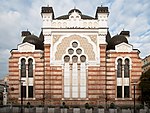
The Sofia Synagogue (Bulgarian: Софийска синагога, Sofiyska sinagoga) is the largest synagogue in Southeastern Europe, one of two functioning in Bulgaria (with the other one in Plovdiv) and the third-largest in Europe.Constructed for the needs of the Bulgarian capital Sofia's mainly Sephardic Jewish community after a project by the Austrian architect Friedrich Grünanger, it resembles the old Moorish Leopoldstädter Tempel in Vienna and was officially opened on 9 September 1909 in the presence of Tsar Ferdinand I of Bulgaria. The first preparations for the synagogue's construction date to 1903, while the construction itself had begun on 13 November 1905. The construction of a grand new synagogue was part of the reorganization efforts of the Bulgarian Jewish community under Lemberg-born Chief Rabbi Marcus Ehrenpreis and local leaders Ezra Tadjer and Avram Davidjon Levy. Prior to the construction of the new synagogue, the lot in central Sofia had been occupied by an older synagogue. One of the architectural monuments of Sofia, the synagogue, located in the very centre of the city near the Central Market Hall, can accommodate 1,300 worshippers. The Sofia Synagogue's main chandelier weighs 1.7 tons and is the largest in the country. Despite the building's size, the services are normally only attended by some 50 to 60 worshippers due to the aliyah of most of Bulgaria's Jews to Israel and the secularity of the local Jewish population. The architectural style is essentially Moorish Revival, with elements of the Vienna Secession and, in the facade, Venetian architecture. The main premise has a diameter of 20 m and is 31 m high. It is topped by an octagonal dome. The interior is richly decorated, featuring columns of Carrara marble and multicoloured Venetian mosaics, as well as decorative woodcarving. The entire building takes up 659 m². The biggest chandelier in the Balkans is there and the rumor said it is made from gold from Ancient Palestine. Since 8 May 1992 the Sofia Synagogue also houses the Jewish Museum of History, which includes the Jewish Communities in Bulgaria, the Holocaust and the Rescue of the Jews in Bulgaria expositions. A souvenir shop is also in operation.

Church of St Petka of the Saddlers

The Church of St Petka of the Saddlers (Bulgarian: Църква „Света Петка Самарджийска“) is a medieval Bulgarian Orthodox church in Sofia, the capital of Bulgaria. It is a small one-naved building partially dug into the ground located in the very centre of both the modern and the antique city, in the TZUM underpass. The church features a semi-cylindrical vault, a hemispherical apse, and a crypt discovered during excavations after the Second World War. The walls are 1 m thick and made from brick and stone. The church was first mentioned in the 16th century and was constructed at the place of a former Roman religious building. It is today a monument of culture known for its mural paintings from the 14th, 15th, 17th and 19th century depicting biblical scenes. The church is dedicated to St Petka, an 11th-century Bulgarian saint. The Church of Saint Petka acquired its present name due to it being a patron of the saddlers in the Middle Ages, who performed their rituals in the church. The adjective samardzhiyski ("of the saddlers") was derived from the Ottoman Turkish word semerci, meaning "saddlemaker". According to one theory, Bulgarian national hero Vasil Levski is buried in the church. Press reports from 1937 retelling the stories of those who carried out a reburial, which might have been for Levski and reports from the 1956 excavation speculating that bones found might have been those indicated by the 1937 press, led to the skeleton labeled "No. 95", being sent for professional examination. When Magdalina Stancheva museologist and head of the Archaeology Department at the Sofia Regional Historical Museum received the bones, she sent them to the laboratory run by Petîr Boev at the Archaeological Institute for examination. The bones were either destroyed by mice or lost. Nikolai Khaitov, a popular writer, accused Stancheva; archaeologists Georgi Dzhingov and Stamen Mikhailov; Krîstiu Miiatev, director of the Archaeological Institute; and Todor Pavlov, president of the National Academy of Bulgaria of participating in a conspiracy to prevent investigation into Levski's burial site and publicly accused Stancheva of mishandling the remains. Two commissions met over the controversy in the 1980s, and confirmed that there was no proof which could substantiate that the bones were Levski's, as the bones were missing.

Kingdom of Bulgaria
Kingdom of Bulgaria

The Tsardom of Bulgaria (Bulgarian: Царство България, romanized: Tsarstvo Balgariya), also referred to as the Third Bulgarian Tsardom (Bulgarian: Трето Българско Царство, romanized: Treto Balgarsko Tsarstvo), sometimes translated in English as Kingdom of Bulgaria (Bulgarian: Крáлство България, romanized: Kralstvo Balgariya), was a constitutional monarchy in Southeastern Europe, which was established on 5 October (O.S. 22 September) 1908, when the Bulgarian state was raised from a principality to a Tsardom.Ferdinand, founder of the royal family, was crowned a Tsar at the Declaration of Independence, mainly because of his military plans and for seeking options for unification of all lands in the Balkans region with an ethnic Bulgarian majority (lands that had been seized from Bulgaria and given to the Ottoman Empire in the Treaty of Berlin). The state was almost constantly at war throughout its existence, lending to its nickname as "the Balkan Prussia". For several years Bulgaria mobilized an army of more than 1 million people from its population of about 5 million, and in the 1910s, it engaged in three wars – the First and Second Balkan Wars, and the First World War. Following the First World War, the Bulgarian army was disbanded and forbidden to exist by the Allied Powers, and all plans for national unification of the Bulgarian lands failed. Less than two decades later, Bulgaria entered the Second World War on the side of the Axis Powers and once again found itself on the losing side, until it switched sides to the Allies in September 1944. In 1946, the monarchy was abolished, its final Tsar was sent into exile, and the Kingdom was replaced by the People's Republic of Bulgaria.