place

Oklahoma Judicial Center

Architecture in OklahomaCourthouses in OklahomaNational Register of Historic Places in Oklahoma City
Oklahoma Historical Society

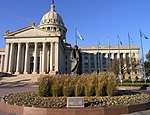
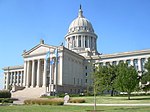
The Oklahoma Judicial Center is the headquarters of the Oklahoma Supreme Court, the Oklahoma Court of Criminal Appeals, and the Judiciary of Oklahoma. Situated near the Oklahoma State Capitol, the original structure, designed by the architectural firm Layton, Hicks & Forsyth, was built between 1929-1930 as the home of the Oklahoma Historical Society and was listed on the National Register of Historic Places as the Oklahoma Historical Society Building in 1990. The society moved to the nearby Oklahoma History Center when it opened in 2005. An annex was completed in 2011.

Excerpt from the Wikipedia article Oklahoma Judicial Center (License: CC BY-SA 3.0, Authors, Images).

Oklahoma Judicial Center
Northeast 32nd Street, Oklahoma City

Geographical coordinates (GPS) Address Nearby Places
placeShow on map

Wikipedia: Oklahoma Judicial CenterContinue reading on Wikipedia

Geographical coordinates (GPS)

Latitude Longitude
N 35.490277777778 ° E -97.501944444444 °
placeShow on map

Address

Oklahoma State Capitol Park

Northeast 32nd Street
73105 Oklahoma City
Oklahoma, United States
mapOpen on Google Maps

Oklahoma Historical Society
Share experience

Nearby Places

Oklahoma House of Representatives

The Oklahoma House of Representatives is the lower house of the legislature of the U.S. state of Oklahoma. Its members introduce and vote on bills and resolutions, provide legislative oversight for state agencies, and help to craft the state's budget. The upper house of the Oklahoma Legislature is the Oklahoma Senate. The Oklahoma Constitution established the powers of the Oklahoma House of Representatives in 1907. Voters further amended those powers through constitutional referenda. One referendum required legislators to balance the annual state budget. Others specified the length and dates of the legislative session. Today, there are 101 House members, each representing a legislative district. District boundaries are redrawn every decade to ensure districts of equal population. Members must be 21 years of age at the time of election and a qualified elector and a resident of the legislative district to serve in the House. The state holds district elections every two years coincident with federal elections and special elections to fill vacant seats. The House meets from early February until the last Friday in May. Members elect a Speaker of the Oklahoma House of Representatives as the presiding officer and a Speaker Pro Tempore, who serves as the presiding officer in his or her absence. Members organize in political party-based caucuses to develop partisan policy agendas. After the 2020 election, Republicans hold a supermajority of the House seats in the 58th Oklahoma Legislature.

Oklahoma Legislature

The Legislature of the State of Oklahoma is the state legislative branch of the U.S. state of Oklahoma. The Oklahoma House of Representatives and Oklahoma Senate are the two houses that make up the bicameral state legislature. There are 101 state representatives, each serving a two-year term, and 48 state senators, who serve four-year terms that are staggered so only half of the Oklahoma Senate districts are eligible in each election cycle. Legislators are elected directly by the people from single member districts of equal population. The Oklahoma Legislature meets annually in the Oklahoma State Capitol in Oklahoma City. The Oklahoma Constitution vests all legislative powers of the state government in the state legislature, which exercises legislative power by enacting Oklahoma law. The legislature may legislate on any subject and has certain "necessary and proper" powers as may be required for carrying into effect the provisions of the Oklahoma Constitution. The powers of the legislature are only limited by the powers reserved to the people, namely initiative and referendum. The Oklahoma Senate and the Oklahoma House of Representatives are co-equal houses, but each chamber has exclusive powers. The Oklahoma Senate's advice and consent is required for gubernatorial appointments to high-level executive positions. Bills for raising revenue may only originate in the Oklahoma House of Representatives. Bills approved by the legislature must be sent to the Governor of Oklahoma for approval.