place

The Maine (Des Moines, Iowa)

Apartment buildings in Des Moines, IowaApartment buildings on the National Register of Historic Places in IowaDes Moines, Iowa stubsIowa building and structure stubsNational Register of Historic Places in Des Moines, Iowa
Polk County, Iowa Registered Historic Place stubsResidential buildings completed in 1913
The Maine
The Maine

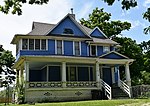
The Maine is a historic building located in Des Moines, Iowa, United States. This three-story, brick structure was completed in 1913. It features 18 units, an "H" plan, a series of ribbon windows, stone lintels and decorative stone trimming. At the rear of the property is a two-story brick automobile garage that shares the historic designation with the apartment building. The date of its construction is uncertain. The building is located on Sixth Avenue, which by the turn of the 20th century had become a major route utilized by vehicular traffic and streetcar lines. Its proximity to this transportation corridor illustrates the emergence of higher and denser residential use in this area of Des Moines. The apartment building and garage were listed together on the National Register of Historic Places in 1996.

Excerpt from the Wikipedia article The Maine (Des Moines, Iowa) (License: CC BY-SA 3.0, Authors, Images).

The Maine (Des Moines, Iowa)
6th Avenue, Des Moines

Geographical coordinates (GPS) Address External links Nearby Places
placeShow on map

Wikipedia: The Maine (Des Moines, Iowa)Continue reading on Wikipedia

Geographical coordinates (GPS)

Latitude Longitude
N 41.608888888889 ° E -93.625166666667 °
placeShow on map

Address

6th Avenue 1635
50314 Des Moines
Iowa, United States
mapOpen on Google Maps

linkWikiData (Q48838296)
linkOpenStreetMap (1041717872)

The Maine
The Maine
Share experience

Nearby Places

Polk County Homestead and Trust Company Addition Historic District

The Polk County Homestead and Trust Company Addition Historic District is a nationally recognized historic district located in Des Moines, Iowa, United States. It was listed on the National Register of Historic Places in 2016. At the time of its nomination the district consisted of 86 resources, including 48 contributing buildings, 11 contributing structures, 18 non-contributing buildings, and nine non-contributing structures. The end of the 19th-century saw the rise of the Victorian suburbs around Des Moines. This was a period of economic growth for the metropolitan area. The largest of these suburbs was North Des Moines. It was connected to Des Moines by way of three streetcar lines, whiched added to its attractiveness. Local real estate investors established the Polk County Homestead & Trust Co. to develop the northern portion of North Des Moines in partnership with the Prospect Park Improvement Company. This area was platted in 1884. Polk County Homestead & Trust Co. bought this property from the Prospect Park Improvement Company, and the two advertised the addition together. The streets, alleys, and large town lots of the plat are laid out on a grid, which differs from the surrounding area's curvilinear streets and irregular lots further north and more erratic development to the south. The historic district's period of significance is 1886 when the first house was built, to 1945 when some of the single-family dwellings were converted into multi-family dwellings. The addition is dominated by the Late Victorian and Colonial Revival styles. The Queen Anne style was popular in this middle and upper-middle-class neighborhood before the Panic of 1893. Five houses are individually listed on the National Register of Historic Places: the Lowry W. and Hattie N. Goode House (1886), the Chaffee-Hunter House (1886), the Dr. John B. and Anna M. Hatton House (c. 1887), the Dr. Anna E. and Andrew A. Johnstone House (1887), and the William A. and Etta Baum Cottage (1891). The former Norman Wiles Seventh-day Adventist School (c. 1925) is the only institutional building in the historic district.

Julius Scheibe Cottage

The Julius Scheibe Cottage at 815 College Ave. in Des Moines, Iowa, United States, was built in 1898. It was a work of architect George E. Hallett. It and the adjacent house (no longer extant) split a corner land parcel and both faced south, while all other houses in the area faced the east or west ends of their parcels. The "parcelization of corner lots" this way increased density and the value of their real estate. Elements of American Movements architecture (American Craftsman architecture)in the house's design include its side-gabled roof, its inset front porch, and also its "symmetrically conceived facade; the facade dormer window with its inset configuration, deck, and bulkheads; the pent roof embellishing the side gables; and the multi-pane windows in the dormer." Houses with similar styling dot the neighborhood, including at the N.S. Wales House at 1814 West 9th Street, also designed by Hallett, and at 1460 5th Avenue. This and other Hallett ones include interior amenities such as fireplaces that are not often found in residences this small.: 12 It was listed on the National Register of Historic Places in 1998. It was deemed significant as an example of "suburban architecture in the former City of North Des Moines, particularly to the stylistic influence of late 19th and early 20th Century American Movements, as practiced in that Victorian suburb and exemplified in the designs of George E. Hallett.": 8