place

Jacob Clearwater House

1874 establishments in OregonHouses completed in 1874Houses in Lane County, OregonNational Register of Historic Places in Lane County, OregonOregon Registered Historic Place stubs
Springfield, OregonUse mdy dates from August 2023
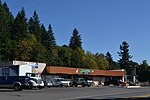
Jacob Clearwater House 1890

The Jacob Clearwater House in Springfield, Oregon was listed on the National Register of Historic Places in 2017. It was home to the Clearwater family who transited the Oregon Trail and homesteaded 320 acres (1.3 km2) in 1865 along the Middle Fork of the Willamette River. It was built in 1874 and is one of only four houses from 1874 or before in the Springfield area.It is a Gothic Revival-style house.The listing includes 43 acres (17 ha) of land containing the house and a historic water tower. The water tower is 10 by 10 feet (3.0 m × 3.0 m) in plan.

Excerpt from the Wikipedia article Jacob Clearwater House (License: CC BY-SA 3.0, Authors, Images).

Jacob Clearwater House
Clearwater Lane, Springfield

Geographical coordinates (GPS) Address Nearby Places
placeShow on map

Wikipedia: Jacob Clearwater HouseContinue reading on Wikipedia

Geographical coordinates (GPS)

Latitude Longitude
N 44.026348 ° E -122.951247 °
placeShow on map

Address

Clearwater Lane 1656
97478 Springfield
Oregon, United States
mapOpen on Google Maps

Jacob Clearwater House 1890
Share experience

Nearby Places

Mount Pisgah Arboretum

The Mount Pisgah Arboretum (85 ha / 209 acres) is a non-profit arboretum and botanical garden located within the Howard Buford Recreation Area (930 ha / 2,300 acre), between the Coast Fork of the Willamette River and the slopes of Mount Pisgah near Eugene-Springfield, Oregon, United States. The Friends of Mount Pisgah Arboretum was established in 1973 when it began to construct trails, build bridges, remove invasive species, and publish newsletters. Wildflower and mushroom shows were first held in 1981; staff hiring began in the early 1980s. The arboretum's original mission was to have international plantings, however most of the early international donations were moved off site. This has changed to maintaining Pacific Northwest plant communities, offer environmental education programs, and provide for public enjoyment of its site.The arboretum includes 7 miles (11 km) of riverside trails with 23 bridges, riparian meadows, evergreen forests, a rare section of preserved oak savanna, Douglas-fir and incense-cedar forests on hillsides, a water garden, wildflower meadows, a wooded picnic area, and restrooms. The White Oak Pavilion took the place of the deteriorating quonset hut shelter in 2005. The arboretum's habitats are home to many species of native mosses, lichens, ferns, shrubs, and wildflowers. 67 families, 231 genera, and 339 plant species have been identified on the site. Wildlife includes bats, deer, coyote, foxes, and other small mammals, the endangered western pond turtle, the sensitive species red-legged frog, tree frogs, gopher and garter snakes, and lizards. Birding is a popular activity in the arboretum, which is home to a variety of migratory and resident songbirds, raptors, and waterfowl. The arboretum publishes a bird checklist, as well as a plant checklist, to aid visitors in identifying the local species. Parking is $4 per car and permits can be purchased at a self-service pay station.

1998 Thurston High School shooting

On May 21, 1998, 15-year-old freshman student Kipland "Kip" Kinkel, opened fire with a semi-automatic rifle in the cafeteria of Thurston High School in Springfield, Oregon, United States, killing two of his classmates and wounding 25 others. He had killed his parents at the family home the day before, following his suspension pending an expulsion hearing after he admitted to school officials that he was keeping a stolen handgun in his locker. Fellow students subdued him, leading to his arrest. He later characterized his actions as an attempt to get others to kill him, since he wanted to take his own life after killing his parents but could not bring himself to. During the year prior to the shooting, Kinkel's increasingly aberrant behavior and fascination with weapons and death had led his parents to take him to a psychologist, who diagnosed major depressive disorder. After he appeared to respond to Prozac, treatment was discontinued and the prescription expired. But Kinkel's parents had not disclosed histories of mental illness in their families, and Kinkel himself had not told anyone about having heard voices urging him to violence since he was 12, out of fear of being ostracized or institutionalized. Since the shootings he has been diagnosed with paranoid schizophrenia and takes antipsychotic medication; his sister and one of the victims believe that better awareness of mental health issues might have averted the shooting. Kinkel pled guilty to murder and attempted murder. He was sentenced to 111 years in prison without the possibility of parole; a sentence upheld on appeal. He is currently incarcerated at the Oregon State Correctional Institution in Salem. The shooting made national news, as the latest in a series of school shootings over the previous year. Kinkel's was seen as more egregious than the earlier ones before since he had gone into a crowded internal space and indiscriminately opened fire with a semi-automatic rifle. President Bill Clinton spoke at the high school a month later about the issue. A memorial outside the school memorializes the two students killed.