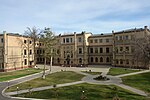
The Turkestan Autonomous Soviet Socialist Republic (Russian: Туркестанская Автономная Советская Социалистическая Республика, romanized: Turkestanskaya Avtonomnaya Sovetskaya Sotsialisticheskaya Respublika; 30 April 1918 – 27 October 1924), originally called the Turkestan Socialist Federative Republic, was an autonomous republic of the Russian Soviet Federative Socialist Republic located in Soviet Central Asia. Uzbeks were the preeminent nation of the Turkestan ASSR. Tashkent was the capital and largest city in the region.
During the Russian Empire, the Turkestan ASSR's territory was governed as Turkestan Krai, the Emirate of Bukhara, and the Khanate of Khiva. From 1905, Pan-Turkist ideologues like Ismail Gasprinski aimed to suppress differences among the peoples who spoke Turkic languages, uniting them into one government.This idea was supported by Vladimir Lenin, and after the Russian Revolution of 1917, the Bolsheviks in Tashkent created the Turkestan ASSR. But in February 1918, the Islamic Council (Uzbek: Shoʻro-i Islomiyya) and the Council of Intelligentsia (Uzb. Shoʻro-i Ulamo) met in Kokand city and declared a rival Turkestan Autonomous Republic, battling Bolshevik forces until the 1920s as part of the conservative Basmachi rebellion.The Turkestan Soviet Federative Republic was officially proclaimed on 30 April 1918.In the late 1917, the TSFR was cut off from the RSFSR by the revolt of the Orenburg Cossacks, but held out, despite being surrounded by hostile states, until the arrival of the Red Army in September 1919 after the Counteroffensive of Eastern Front.Meanwhile, a power struggle among the Communists ensued between those favoring a Pan-Turkist government like Turar Ryskulov and Tursun Khojaev, and those in favor of dividing Soviet Turkestan into smaller ethnic or regional units, such as Fayzulla Xoʻjayev and Akmal Ikramov. The latter group won, as national delimitation in Central Asia began in 1924. Upon dissolution, the Turkestan ASSR was split into Uzbek SSR (now Uzbekistan), Turkmen SSR (now Turkmenistan) with the Tajik ASSR (now Tajikistan), Kara-Kirghiz Autonomous Oblast (now Kyrgyzstan), and Karakalpak Autonomous Oblast (now Autonomous Republic of Uzbekistan as Karakalpakstan).
 Continue reading on Wikipedia