place

Battle of Calatañazor

Battles in Castile and LeónBattles of the ReconquistaConflicts in 1002Spanish folkloreSpanish legends

The Battle of Calatañazor was a legendary battle of the Reconquista that supposedly took place in July 1002 in municipality Calatañazor in the province of Soria between an army of invading Moors under Almanzor and a force of Christian allies led by Alfonso V of León, Sancho III of Navarre, and Sancho García of Castile. Almanzor, who historically died the night of 10–11 August, is said to have died of wounds received in the battle. The battle of Calatañazor has been branded as unreal since the 18th century due to the non-existence of any evidence in the chronicles of the time. Its ahistoricity was first demonstrated by Reinhart Dozy in 1881. The French Arabist Évariste Lévi-Provençal attributed the destruction of San Millán de la Cogolla by the Saracens to the campaign in municipality Calatañazor.

Excerpt from the Wikipedia article Battle of Calatañazor (License: CC BY-SA 3.0, Authors).

Battle of Calatañazor
Rue Bellini, Paris Paris 16e Arrondissement (Paris)

Geographical coordinates (GPS) Address Nearby Places
placeShow on map

Wikipedia: Battle of CalatañazorContinue reading on Wikipedia

Geographical coordinates (GPS)

Latitude Longitude
N 41.7 ° E -2.816 °
placeShow on map

Address

Rue Bellini 6
75116 Paris, Paris 16e Arrondissement (Paris)
Île-de-France, France
mapOpen on Google Maps

Share experience

Nearby Places

Calatañazor
Calatañazor

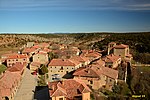
Calatañazor is a municipality located in the province of Soria, Castile and León, Spain. According to the 2010 census (INE), the municipality has a population of 70 inhabitants. The municipality is named after the tiny fortified city on top of a hill. Also situated in the municipality are the hamlets Aldehuela and Abioncillo. Abioncillo used to be abandoned like many forsaken hamlets in Spain, but in the 1980s was turned around by a few dedicated teachers into an educational center. In the valley between Calatañazor and Abioncillo, the Battle of Calatañazor took place in 1002. This place is still named El valle de la sangre (the valley of blood). Almanzor, the ruler of Muslim Al-Andalus is by some historians said to have died in this battle and was buried in Medinaceli. There is a statue of him in Calatañazor. A certain kind of juniper tree, the Juniperus thurifera (Spanish juniper), grows in a close forest in the nature reserve of El Sabinar de Calatañazor. Some are the biggest to be found in the whole Iberian peninsula. Some more are found close to an underground river, the Abión, which surfaces at the Fuentona de Muriel, a natural heritage site. The Fuentona (spring) is often visited, especially by advanced cave divers. The locals call this spring El Ojo de la Mar (the eye of the sea). In the vicinity of Abioncillo, some 4000-year-old drawings are found in La Cueva Maja. Both in the center of Abioncillo and Calatañazor, some centuries old elms can be found, as in Celt-Iberian times were an important symbol. The name Calatañazor comes from the Arab Qalat al-Nusur which can either mean "Castle of Azure" or "Castle of Vultures".