place

Mendoza, Argentina

1561 establishments in South America1561 establishments in the Spanish EmpireCapitals of Argentine provincesCities in ArgentinaMendoza, Argentina
Pages with Latin American Spanish IPAPages with non-numeric formatnum argumentsPopulated places established in 1561Populated places in Mendoza Province
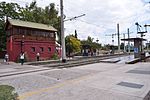
Downtown Mendoza
Downtown Mendoza

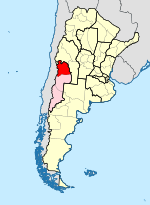
Mendoza (Latin American Spanish: [menˈdosa]), officially the City of Mendoza (Spanish: Ciudad de Mendoza), is the capital of the province of Mendoza in Argentina. It is located in the northern-central part of the province, in a region of foothills and high plains, on the eastern side of the Andes. As of the 2010 census [INDEC], Mendoza had a population of 115,041 with a metropolitan population of 1,055,679, making Greater Mendoza the fourth largest census metropolitan area in the country. Ruta Nacional 7, the major road running between Buenos Aires and Santiago, runs through Mendoza. The city is a frequent stopover for climbers on their way to Aconcagua (the highest mountain in the Western and Southern Hemispheres) and for adventure travelers interested in mountaineering, hiking, horse riding, rafting, and other sports. In the winter, skiers come to the city for easy access to the Andes. Two of the main industries of the Mendoza area are olive oil production and Argentine wine. The region around Greater Mendoza is the largest wine-producing area in South America. As such, Mendoza is one of the eleven Great Wine Capitals, and the city is an emerging enotourism destination and base for exploring the region's hundreds of wineries located along the Argentina Wine Route.

Excerpt from the Wikipedia article Mendoza, Argentina (License: CC BY-SA 3.0, Authors, Images).

Mendoza, Argentina
Correa Saa,

Geographical coordinates (GPS) Address Nearby Places
placeShow on map

Wikipedia: Mendoza, ArgentinaContinue reading on Wikipedia

Geographical coordinates (GPS)

Latitude Longitude
N -32.883333333333 ° E -68.816666666667 °
placeShow on map

Address

Correa Saa

Correa Saa
M5500CJI , Distrito San José
Mendoza, Argentina
mapOpen on Google Maps

Downtown Mendoza
Downtown Mendoza
Share experience

Nearby Places

Trolleybuses in Mendoza

The Mendoza trolleybus system (Spanish: Sistema de trolebuses de Mendoza) formed part of the public transport network in Mendoza, the capital city of Mendoza Province, Argentina. It is owned by the provincial government. Opened in 1958, the system expanded to three routes by 1961 and remained relatively static in size and configuration until 1989, when a fourth route opened. Additional routes opened in 2004 and 2005, bringing the system to its maximum extent of six routes, which linked the city center with some of its metropolitan suburbs. However, one of the original routes (Villanueva) was suspended from 2005 to 2011, and consequently no more than five routes were operating concurrently during that period. In the 2010s, the provincial government entity that had always operated the system, the Empresa Provincial de Transportes de Mendoza (EPTM), began to experience increasingly worsening financial problems, due in large part to difficulties in keeping its fleet of approximately 30-year-old trolleybuses operating reliably. Construction projects around the city, including work on the new Metrotranvía Mendoza light rail system, also disrupted trolleybus service, and the actual number of trolleybuses in service declined considerably. At the end of 2016, the provincial legislature voted to dissolve EPTM entirely and replace it with a new company, the Sociedad de Transporte de Mendoza (STM), and this change was put into effect on 1 January 2017. All remaining trolleybus service was suspended on 4 May 2017. A plan to make the suspension a permanent closure gave way to one calling for retention of trolleybus service on one route, the Parque route (the system's very first route, dating to 1958), with the other five routes permanently closed. The suspension lasted 16 months, and trolleybus service resumed on the Parque route in January 2019. Service was discontinued again in February 2021.