place

St. Joseph's Cathedral, Tehran

Asian church stubsCathedrals in TehranChaldean Catholic cathedralsEastern Catholic cathedrals in IranEastern Catholic church stubs
Iranian building and structure stubsMiddle Eastern church stubs
St. Joseph Assyrian Catholic Church, Tehran

St. Joseph Assyrian Catholic Church (Persian: کلیسای جامع سنت جوزف کاتولیک آشوری), also called the Chaldean Catholic cathedral of Tehran, is a Catholic Church building in Tehran, Iran, in which the Chaldean rite is followed. It is located north of Enqelab Street, Shahid Abbas Moussavi. It should not be confused with Tehran's Cathedral of the Consolata (where the Latin rite is followed), nor with the Apostolic Armenian Saint Sarkis Cathedral. It functions as the seat of the Chaldean Catholic Archeparchy of Tehran (Archidioecesis Teheranensis Chaldaeorum), a jurisdiction created for Catholics of the Chaldean rite that was established in 1853 and moved to Teheran in 1944 under the pontificate of Pope Pius XII who depends on the Congregation for the Oriental Churches (Congregatio pro Ecclesiis Orientalibus). Currently it is under the pastoral responsibility of the Archbishop Ramzi Garmou.

Excerpt from the Wikipedia article St. Joseph's Cathedral, Tehran (License: CC BY-SA 3.0, Authors, Images).

St. Joseph's Cathedral, Tehran
شهید جانی بت اوشانا, Tehran District 6

Geographical coordinates (GPS) Address External links Nearby Places
placeShow on map

Wikipedia: St. Joseph's Cathedral, TehranContinue reading on Wikipedia

Geographical coordinates (GPS)

Latitude Longitude
N 35.704694444444 ° E 51.42175 °
placeShow on map

Address

کلیسای جامع سنت جوزف (Chaldean Catholic cathedral of Tehran)

شهید جانی بت اوشانا
15819-63611 Tehran, District 6
Iran
mapOpen on Google Maps

linkWikiData (Q28519114)
linkOpenStreetMap (8488813698)

St. Joseph Assyrian Catholic Church, Tehran
Share experience

Nearby Places

Iran hostage crisis
Iran hostage crisis

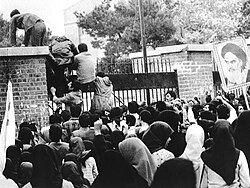
The Iran hostage crisis (Persian: بحران گروگانگیری سفارت آمریکا) began on November 4, 1979, when 66 Americans, including diplomats and other civilian personnel, were taken hostage at the Embassy of the United States in Tehran, with 52 of them being held until January 20, 1981. The incident occurred after the Muslim Student Followers of the Imam's Line stormed and occupied the building in the months following the Iranian Revolution. With support from Ruhollah Khomeini, who had led the Iranian Revolution and would eventually establish the present-day Islamic Republic of Iran, the hostage-takers demanded that the United States extradite Iranian king Mohammed Reza Pahlavi, who had been granted asylum by the Carter administration for cancer treatment. Notable among the assailants were Hossein Dehghan (future Minister of Defense of Iran), Mohammad Ali Jafari (future Commander-in-Chief of the Islamic Revolutionary Guard Corps), and Mohammad Bagheri (future Chief of the General Staff of the Iranian Armed Forces). The hostage crisis was a pivotal episode in the history of Iran–United States relations, formally sparking the ongoing Iran–United States conflict. After 444 days, it came to an end with the signing of the Algiers Accords between the Iranian and American governments; Iran's king had died in Cairo, Egypt, on July 27, 1980. The American magazine Time described the Iran hostage crisis as an entanglement of vengeance and mutual incomprehension. American president Jimmy Carter called the hostage-taking an act of "blackmail" and the hostages "victims of terrorism and anarchy." Among proponents of the Iranian Revolution, it was seen as an act against perceived attempts by the United States to undermine the uprising against Iran's king, who had been accused of committing numerous human rights abuses against Iranian dissidents through his Bureau for Intelligence and Security of the State. The Carter administration's refusal to extradite Pahlavi was cited by the hostage-takers as proof of complicity on the part of the United States, which, in turn, denounced the Iranians' hostage-taking as an egregious violation of the principles of international law, such as the Vienna Convention, under which diplomats and diplomatic compounds are to be granted immunity from coercion and harassment. Six American diplomats who had evaded capture were rescued by the "Canadian Caper" on January 27, 1980. As Iran hostage crisis negotiations dragged out and did not secure the release of the remaining hostages, Carter approved Operation Eagle Claw on April 24, 1980. The effort failed, however, resulting in the death of one Iranian civilian and eight American soldiers, prompting Secretary of State Cyrus Vance to resign from his position. By September 1980, the beginning of the Iraqi invasion of Iran spurred the Iranian government to negotiate with the United States as part of an initiative mediated by Algeria. Political analysts cited the standoff as a major factor in the downfall of Carter's presidency, culminating in his landslide loss in the 1980 presidential election. The hostages were formally released into American custody one day after the Algiers Accords were signed, just minutes following the first inauguration of Ronald Reagan. In Iran, the crisis strengthened the prestige of Khomeini and the political power of theocrats who opposed normalization with the Western world. Since then, the United States has enforced international sanctions against Iran, which further weakened ties between the two countries.

Kharazmi University

Kharazmi University (Abbreviation: KHI) (Persian: دانشگاه خوارزمی, Daneshgah-e Xuarazmi) [Former Name: Tehran University of Teacher Training (Persian: دانشگاه تربیت معلم سابق)] is a major public research university in Iran, KHI named after Khwarizmi (c. 780–850), Persian mathematician, astronomer and geographer, offering a wide range of undergraduate and postgraduate programs in a variety of disciplines. KHI is considered as the oldest institution of higher education in Iran. It was established in 1919 as the Central Teachers' Institute and gained university status as Tarbiat Moallem University of Tehran in 1974. It changed its name to Kharazmi University on January 31, 2012.In 2015, the University of Economic Sciences (founded in 1936) was merged into Kharazmi University as its faculty of management, faculty of financial sciences and faculty of economics. The university has two main campuses, the main campus including administration offices located in Tehran, another is in the Hesarak district of Karaj.Currently, KHI accepts students in various fields of basic sciences, humanities, literature education and engineering at different levels from bachelor's to doctorate even post-doctorate and higher levels. kharazmi is one of the state universities affiliated to the Ministry of Science, Research and Technology of Iran, which is named after Mohammad bin Musa Khwarazmi, an Iranian scientist of the 3rd century AH, and is located in Tehran and a campus in the city of Karaj, the capital of Alborz province. This university has changed its name several times. The president of this university is Ali Hasan Beigi and the founder of university is Isa Seddigh.This old university was registered in the list of national monuments of Iran by UNESCO on the first date of Mehr month 1382 AH under number 10410.The architect of the KHI university is the Russian engineer Markov. Among the construction materials used in the construction of this building, plastering, tiling, inscriptions, etc. can be mentioned. KHI School of Engineering and business school won international rankings of 601-800th in 2019, 2020, and 2021 in 351-400. in 2023 8th in Iran and 400-451 in the world. It ranked 6th and 10th in industrial incomes among Iranian universities Especially Business school in 2020 and Civil Engineering, Economy Education And MBA.