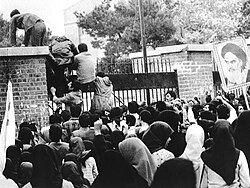
The Iran hostage crisis (Persian: بحران گروگانگیری سفارت آمریکا) began on November 4, 1979, when 66 Americans, including diplomats and other civilian personnel, were taken hostage at the Embassy of the United States in Tehran, with 52 of them being held until January 20, 1981. The incident occurred after the Muslim Student Followers of the Imam's Line stormed and occupied the building in the months following the Iranian Revolution. With support from Ruhollah Khomeini, who had led the Iranian Revolution and would eventually establish the present-day Islamic Republic of Iran, the hostage-takers demanded that the United States extradite Iranian king Mohammed Reza Pahlavi, who had been granted asylum by the Carter administration for cancer treatment. Notable among the assailants were Hossein Dehghan (future Minister of Defense of Iran), Mohammad Ali Jafari (future Commander-in-Chief of the Islamic Revolutionary Guard Corps), and Mohammad Bagheri (future Chief of the General Staff of the Iranian Armed Forces). The hostage crisis was a pivotal episode in the history of Iran–United States relations, formally sparking the ongoing Iran–United States conflict. After 444 days, it came to an end with the signing of the Algiers Accords between the Iranian and American governments; Iran's king had died in Cairo, Egypt, on July 27, 1980.
The American magazine Time described the Iran hostage crisis as an entanglement of vengeance and mutual incomprehension. American president Jimmy Carter called the hostage-taking an act of "blackmail" and the hostages "victims of terrorism and anarchy." Among proponents of the Iranian Revolution, it was seen as an act against perceived attempts by the United States to undermine the uprising against Iran's king, who had been accused of committing numerous human rights abuses against Iranian dissidents through his Bureau for Intelligence and Security of the State. The Carter administration's refusal to extradite Pahlavi was cited by the hostage-takers as proof of complicity on the part of the United States, which, in turn, denounced the Iranians' hostage-taking as an egregious violation of the principles of international law, such as the Vienna Convention, under which diplomats and diplomatic compounds are to be granted immunity from coercion and harassment.
Six American diplomats who had evaded capture were rescued by the "Canadian Caper" on January 27, 1980. As Iran hostage crisis negotiations dragged out and did not secure the release of the remaining hostages, Carter approved Operation Eagle Claw on April 24, 1980. The effort failed, however, resulting in the death of one Iranian civilian and eight American soldiers, prompting Secretary of State Cyrus Vance to resign from his position. By September 1980, the beginning of the Iraqi invasion of Iran spurred the Iranian government to negotiate with the United States as part of an initiative mediated by Algeria.
Political analysts cited the standoff as a major factor in the downfall of Carter's presidency, culminating in his landslide loss in the 1980 presidential election. The hostages were formally released into American custody one day after the Algiers Accords were signed, just minutes following the first inauguration of Ronald Reagan. In Iran, the crisis strengthened the prestige of Khomeini and the political power of theocrats who opposed normalization with the Western world. Since then, the United States has enforced international sanctions against Iran, which further weakened ties between the two countries.

 Continue reading on Wikipedia