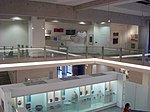
The Universidad de San Carlos de Guatemala (USAC, University of San Carlos of Guatemala) is the largest and oldest university of Guatemala; it is also the fourth founded in the Americas. Established in the Kingdom of Guatemala during the Spanish colony, it was the only university in Guatemala until 1954, although it continues to hold distinction as the only public university in the entire country.
The university has had five major transformations:
Royal and Pontifical University of San Carlos Borromeo (1676–1829): Established during the colony by the Spanish Crown in the 17th century, approved by the Vatican and directed by regular orders of the Catholic Church. After the Independence in 1821, it was called Pontifical University.
Academia de Ciencias (Academy of Science) (1834–1840): a secular institution created during the Central American Federation by the liberal governor Mariano Galvez.
Pontifical University of San Carlos Borromeo (1840–1875): an ecclesiastical institution run by the regular orders during the governments of Rafael Carrera and Vicente Cerna y Cerna, ratified by the Concordat of 1854.
National University of Guatemala' (1875–1944): a secular and positivist institution divided into colleges of Notary and Law, Medicine and Pharmacy.
University of San Carlos of Guatemala (1944- ): a socially oriented secular institution established after the Revolution of 1944.The university grew out of the Colegio de Santo Tomás de Aquino (Saint Thomas Aquinas High School), founded in 1562 by Bishop Francisco Marroquín. After a series of major earthquakes in 1773, which destroyed many parts of the city of Santiago de los Caballeros, the crown authorities ordered the evacuation of the city and the relocation of its government, religious and university functions to the new capital La Nueva Guatemala de la Asunción, the university's present location. In the early years, from the 16th to 19th centuries, it offered studies in civil and liturgical law, theology, philosophy, medicine and indigenous languages.
However, their activities were interrupted after the Independence of Central America in 1821. At that time, each province of the former Captaincy General of Guatemala promoted the creation of a local university. The university remained as an institution in Guatemala, but it closed in 1829, after the conservative criollos were expelled from Central America, and in 1834 converted into the "Academy of Sciences". In 1840, with the comeback of the conservatives, it was turned into the "Pontifical University of San Carlos Borromeo" once again and even for a short period between 1918 and 1920, it was called "Estrada Cabrera University" in honor of the then president, lawyer Manuel Estrada Cabrera. After the Revolution of October 1944, the USAC managed to obtain total autonomy, but from 1954, with the resurgence of Catholic education and the establishment of private universities, an attrition process of the university began, which included constant nonpayment of the budget percentage that corresponds to the university by the Constitution and the persecution and assassination of student leaders and faculty members throughout the duration of the Guatemala Civil War (1960–1996).
 Continue reading on Wikipedia