place

Memphis Union Station

1912 establishments in TennesseeBeaux-Arts architecture in TennesseeBuildings and structures in Memphis, TennesseeDemolished railway stations in the United StatesFormer Louisville and Nashville Railroad stations
Former Missouri Pacific Railroad stationsFormer Southern Railway (U.S.) stationsFormer St. Louis Southwestern Railway stationsFormer railway stations in TennesseeRailway stations in the United States closed in 1964Railway stations in the United States closed in 1968Railway stations in the United States opened in 1912Railway stations in the United States opened in 1966Transportation in Memphis, TennesseeUnion stations in the United States
MUS 1
MUS 1

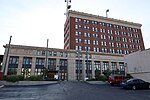
Memphis Union Station was a passenger terminal in Memphis, Tennessee. It served as a hub between railroads of the Southwest, the Missouri Pacific Railroad and the St. Louis Southwestern Railway, and railroads of the Southeast, the Louisville and Nashville Railroad, the Nashville, Chattanooga and St. Louis Railway and the Southern Railway. The terminal, completed in 1912, was built in the Beaux-Arts style and was located on Calhoun Street, between south Second Street and Rayburn Boulevard (now south Third Street). It was demolished in 1969. This location in south Memphis was approximately two blocks east of the other major Memphis railroad terminal, Memphis Grand Central Station.

Excerpt from the Wikipedia article Memphis Union Station (License: CC BY-SA 3.0, Authors, Images).

Memphis Union Station
East G. E. Patterson Avenue, Memphis

Geographical coordinates (GPS) Address Nearby Places
placeShow on map

Wikipedia: Memphis Union StationContinue reading on Wikipedia

Geographical coordinates (GPS)

Latitude Longitude
N 35.1322226 ° E -90.0555408 °
placeShow on map

Address

East G. E. Patterson Avenue
38126 Memphis
Tennessee, United States
mapOpen on Google Maps

MUS 1
MUS 1
Share experience

Nearby Places

Assassination of Martin Luther King Jr.

Martin Luther King Jr., an African-American clergyman and civil rights leader, was fatally shot at the Lorraine Motel in Memphis, Tennessee, on April 4, 1968, at 6:01 p.m. CST. He was rushed to St. Joseph's Hospital, where he died at 7:05 p.m. He was a prominent leader of the civil rights movement and a Nobel Peace Prize laureate who was known for his use of nonviolence and civil disobedience. James Earl Ray, a fugitive from the Missouri State Penitentiary, was arrested on June 8, 1968, at London's Heathrow Airport, extradited to the United States and charged with the crime. On March 10, 1969, he pleaded guilty and was sentenced to 99 years in the Tennessee State Penitentiary. He later made many attempts to withdraw his guilty plea and to be tried by a jury, but was unsuccessful. Ray died in prison in 1998.The King family and others believe that the assassination was the result of a conspiracy involving the U.S. government, the mafia, and Memphis police, as alleged by Loyd Jowers in 1993. They believe that Ray was a scapegoat. In 1999, the family filed a wrongful-death lawsuit against Jowers for the sum of $10 million. During closing arguments, their attorney asked the jury to award damages of $100, to make the point that "it was not about the money". During the trial, both sides presented evidence alleging a government conspiracy. The accused government agencies could not defend themselves or respond because they were not named as defendants. Based on the evidence, the jury concluded that Jowers and others were "part of a conspiracy to kill King" and awarded the family the symbolic $100 they requested in damages. The allegations and the finding of the Memphis jury were later disputed by the United States Department of Justice in 2000 due to perceived lack of evidence.The assassination was one of four major assassinations of the 1960s in the United States, coming several years after the assassination of John F. Kennedy in 1963 and the assassination of Malcolm X in 1965, and two months before the assassination of Robert F. Kennedy in June 1968.