place

Peshawar Morr Interchange

Bridges in PakistanIslamabadRoad interchanges in PakistanUse Pakistani English from July 2021
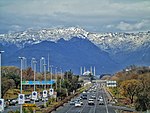
Islamabad Highway From the 9th avenue bridge

Peshawar Morr Interchange (also known as G-9 interchange) is Pakistan's biggest interchange in Islamabad, Pakistan. It is located at the intersection of Srinagar Highway and the Ninth Avenue, connecting the G and H sectors of Islamabad. Peshawar Morr interchange eased traffic congestion on two main highways of the capital city i.e. Srinagar Highway and Ninth Avenue. It facilitates traffic to the Islamabad International Airport and to Lahore–Islamabad Motorway and Islamabad–Peshawar Motorway.The total length of the overhead, underground and ramp roads of the interchange is approximately 14 km and it features eight flyovers.The construction of interchange started in May 2014 along with the construction of Rawalpindi-Islamabad Metrobus, but took longer to complete than anticipated. It costed almost Rs. 6 billion (60 million USD) to get completed by March 2016.

Excerpt from the Wikipedia article Peshawar Morr Interchange (License: CC BY-SA 3.0, Authors, Images).

Peshawar Morr Interchange
Srinagar Highway, Islamabad G-9/4

Geographical coordinates (GPS) Address Nearby Places
placeShow on map

Wikipedia: Peshawar Morr InterchangeContinue reading on Wikipedia

Geographical coordinates (GPS)

Latitude Longitude
N 33.68453 ° E 73.04756 °
placeShow on map

Address

Metro Bus Terminal Peshawar Mor

Srinagar Highway
44000 Islamabad, G-9/4
Islamabad Capital Territory, Pakistan
mapOpen on Google Maps

Islamabad Highway From the 9th avenue bridge
Share experience

Nearby Places

Islamabad
Islamabad

Islamabad (; Urdu: اسلام‌آباد, romanized: Islāmābād, ; transl. 'City of Islam') is the capital city of the Islamic Republic of Pakistan. It is the country's ninth-most populous city with a population of over 1.2 million people and is federally administered by the Pakistani government as part of the Islamabad Capital Territory. Built as a planned city in the 1960s and established in 1967, it replaced Karachi as Pakistan's official national capital. The Greek architect Constantinos Apostolou Doxiadis developed Islamabad's master plan, in which he divided it into eight zones; administrative, diplomatic enclave, residential areas, educational and industrial sectors, commercial areas, as well as rural and green areas administered by the Islamabad Metropolitan Corporation with support from the Capital Development Authority. Islamabad is known for its parks and forests, including the Margalla Hills National Park and the Shakarparian. It is home to several landmarks, including the country's flagship Faisal Mosque, which is the world's fifth-largest mosque. Other prominent landmarks include the Pakistan Monument and Democracy Square.Rated as Gamma + by the Globalization and World Cities Research Network, Islamabad has the highest cost of living in Pakistan. The city's populace is dominated by both middle and upper-middle class citizens. Islamabad is home to twenty universities, including Bahria University, Quaid-e-Azam University, PIEAS, COMSATS University, and NUST. It is also rated as one of the safest cities in Pakistan and has an expansive RFID-enabled surveillance system with almost 2,000 active CCTV cameras.