place

Ellen Cove Jetty

1901 establishments in AustraliaHeritage places in Albany, Western AustraliaSouth coast of Western AustraliaUse Australian English from May 2016Wharves in Australia
Ellencove
Ellencove

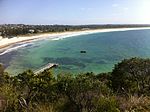
Ellen Cove Jetty also known as Middleton Beach Jetty is a jetty found at the southern end of Middleton Beach in King George Sound in Albany in the Great Southern region of Western Australia.Work commenced on the jetty with piles being driven into the sand bed at Ellen Cove in late 1899; construction was completed in 1901, at a cost of £150.The jetty served in the transport of goods and people of Albany. It is now primarily used for recreational purposes.It is constructed from reinforced concrete and wood, 15 concrete piles set at regular intervals with wooden decking spanning the piles. The jetty has been rebuilt several times with no evidence that any of the original structure remains.Both the jetty and the mature Norfolk Island pine trees along the shoreline were listed with the Heritage Council of Western Australia in 2000.The Middleton Beach shark barrier was built in 2016 enclosing the waters around the jetty.

Excerpt from the Wikipedia article Ellen Cove Jetty (License: CC BY-SA 3.0, Authors, Images).

Ellen Cove Jetty
Ellen Cove Boardwalk, Albany Middleton Beach (Port Albany)

Geographical coordinates (GPS) Address Nearby Places
placeShow on map

Wikipedia: Ellen Cove JettyContinue reading on Wikipedia

Geographical coordinates (GPS)

Latitude Longitude
N -35.02574 ° E 117.9172 °
placeShow on map

Address

Ellen Cove Boardwalk

Ellen Cove Boardwalk
6332 Albany, Middleton Beach (Port Albany)
Western Australia, Australia
mapOpen on Google Maps

Ellencove
Ellencove
Share experience

Nearby Places

Esplanade Hotel, Albany

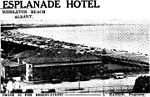
The Esplanade Hotel was a hotel that once stood overlooking Middleton Beach in Albany, Western Australia. The hotel was demolished in January 2007 by Singaporean owners, WCP Plaza, to make way for an 81-room hotel, function centre, village square, shops and health and recreation facilities. The proposal for the new hotel was approved in 2007 by the City of Albany. The council also supported the rezoning of several locations in Earl Street and Barry Court to allow the development of the hotel. The site remains vacant in 2015. The original hotel was built on the site in 1898, with several different hotels being built in the same space over the years. In 1908 the hotel, insured for £2000, burned to the ground. An inquest into the cause of the fire was held, but no evidence could be found on how the fire originated. A new hotel was built and opened in April 1911, replete with modern conveniences such as septic tank, hot water, electric bells and telephones.The last hotel to be built on the site was constructed by entrepreneur Paul Terry in 1991. Paul Terry was killed in a freak helicopter crash in Hawaii in 1993 and the hotel passed out of the family's management, and was eventually sold.The building was demolished in 2007 to build the new hotel, village square, health and recreation facilities, and function centres. Tasmania-based architect, Morris Nunn, and planning consultant, David Caddy, were hired to develop the hotel with an international hotel operator. However, financial problems resulting from the financial crisis of 2007–2008 followed and the project was delayed. In 2008, Albany Mayor Milton Evans announced that plans to develop the hotel had not changed. In 2010, the entity placed the 13,171 square metres (15,752 sq yd) site on the market for A$15 million.Local dissatisfaction at the lack of action at the site and the unattractiveness of the area lead to a yarn bombing, with a large hand made sign being stitched onto the perimeter fence; the sign was removed after three days. A necktie protest followed which was also quickly taken down, protesters then held a sock protest at the vacant site in 2010, hanging thousands of socks along the fence of the vacant site. The socks were later removed at the request of the real estate agent to give the land a greater chance of being sold.The Premier, Colin Barnett, threatened to take back ownership of the land in 2013 after it had been lying vacant for so long, contributing to a lack of accommodation in the city.In 2014, the state government acquired the site for A$7 million, partially sponsored with a A$3.3 million grant from the Royalties for Regions program.In December 2020 it was revealed Pacifica Developments and Ausglobal Group had agreed to buy the 3700sqm vacant site to build a $25-$30 million hotel to be operated by Seashells Hospitality Group.

Old Farm, Strawberry Hill

The Old Farm, now known as Strawberry Hill/Barmup is located on Strawberry Hill in the suburb of Mira Mar in Albany, Western Australia. It is known as being the first farm in Western Australia.The hill on which the property is situated rises to a height of 72 metres (237 ft) and is a spur of Mount Clarence. The soil is a mixture of clay and gravel with rich black loam on the lower side.The farm was initially established in 1827 as a government farm when the first Europeans settled at King George Sound. Edmund Lockyer, Alexander Collie and John Lawrence Morley selected the site as a government farm. Originally it occupied an area of 622 hectares (1,536 acres) but only 2 hectares (6 acres) remain today. The next three commandants of the settlement, Captain Wakefield, Lieutenant Sleeman and Captain Collet Barker, followed Lockyer's plan of continuing to develop the farm. Alexander Collie was appointed Government Resident of Albany in 1831 and moved into a wattle and daub cottage situated on the farm. He named the property Strawberry Hill after the small plot of strawberries he was cultivating. Collie retired in 1832 and his successor was D. H. Macleod but it was the farm superintendent John Lawrence Morley who handed the property onto Richard Spencer. Spencer was appointed as Government Resident in 1833; he acquired the farm and resided there with his wife, Ann, and his ten children. Spencer arranged for the erection of a granite two-storey building at the rear end of the original wattle and daub structure at a cost of £100. The garden was now well established and producing blood oranges, raspberries, grapes, asparagus, figs and almonds. The first visitors to stay in the new building included Charles Darwin and Captain Robert FitzRoy, of HMS Beagle.The old thatched roof wattle and daub part of the main residence burned down in 1870. A second cottage was built by Charles Miner in the same year.Francis Bird, the Chief Architect of Western Australia, acquired the property in 1889 and changed the name from Strawberry Hill to the Old Farm. His family retained ownership of the farm until the 1950s.The site lay derelict for many years until being purchased by the Federal Government in 1956 and it was then vested in the National Trust of Australia in 1964. Conservation work commenced shortly afterward and it was later opened to the public.