place

Point King Lighthouse

1858 establishments in AustraliaDisused lighthouses in AustraliaHeritage places in Albany, Western AustraliaLighthouses completed in 1858Lighthouses in Western Australia
State Register of Heritage Places in the City of Albany
Old forts Lhouse alb

Point King Lighthouse was a lighthouse located on the northern entrance to Princess Royal Harbour in Albany in the Great Southern region of Western Australia. The lighthouse was the first navigational light for the Port of Albany and the second lighthouse to be built on the West Australian coastline.

Excerpt from the Wikipedia article Point King Lighthouse (License: CC BY-SA 3.0, Authors, Images).

Point King Lighthouse
Ellen Cove Boardwalk, Albany Seppings (Port Albany)

Geographical coordinates (GPS) Address Nearby Places
placeShow on map

Wikipedia: Point King LighthouseContinue reading on Wikipedia

Geographical coordinates (GPS)

Latitude Longitude
N -35.035027777778 ° E 117.91825 °
placeShow on map

Address

Ellen Cove Boardwalk
6332 Albany, Seppings (Port Albany)
Western Australia, Australia
mapOpen on Google Maps

Old forts Lhouse alb
Share experience

Nearby Places

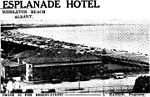
Esplanade Hotel, Albany

The Esplanade Hotel was a hotel that once stood overlooking Middleton Beach in Albany, Western Australia. The hotel was demolished in January 2007 by Singaporean owners, WCP Plaza, to make way for an 81-room hotel, function centre, village square, shops and health and recreation facilities. The proposal for the new hotel was approved in 2007 by the City of Albany. The council also supported the rezoning of several locations in Earl Street and Barry Court to allow the development of the hotel. The site remains vacant in 2015. The original hotel was built on the site in 1898, with several different hotels being built in the same space over the years. In 1908 the hotel, insured for £2000, burned to the ground. An inquest into the cause of the fire was held, but no evidence could be found on how the fire originated. A new hotel was built and opened in April 1911, replete with modern conveniences such as septic tank, hot water, electric bells and telephones.The last hotel to be built on the site was constructed by entrepreneur Paul Terry in 1991. Paul Terry was killed in a freak helicopter crash in Hawaii in 1993 and the hotel passed out of the family's management, and was eventually sold.The building was demolished in 2007 to build the new hotel, village square, health and recreation facilities, and function centres. Tasmania-based architect, Morris Nunn, and planning consultant, David Caddy, were hired to develop the hotel with an international hotel operator. However, financial problems resulting from the financial crisis of 2007–2008 followed and the project was delayed. In 2008, Albany Mayor Milton Evans announced that plans to develop the hotel had not changed. In 2010, the entity placed the 13,171 square metres (15,752 sq yd) site on the market for A$15 million.Local dissatisfaction at the lack of action at the site and the unattractiveness of the area lead to a yarn bombing, with a large hand made sign being stitched onto the perimeter fence; the sign was removed after three days. A necktie protest followed which was also quickly taken down, protesters then held a sock protest at the vacant site in 2010, hanging thousands of socks along the fence of the vacant site. The socks were later removed at the request of the real estate agent to give the land a greater chance of being sold.The Premier, Colin Barnett, threatened to take back ownership of the land in 2013 after it had been lying vacant for so long, contributing to a lack of accommodation in the city.In 2014, the state government acquired the site for A$7 million, partially sponsored with a A$3.3 million grant from the Royalties for Regions program.In December 2020 it was revealed Pacifica Developments and Ausglobal Group had agreed to buy the 3700sqm vacant site to build a $25-$30 million hotel to be operated by Seashells Hospitality Group.

Quaranup
Quaranup

Quaranup, also known a Camp Quaranup and Albany Quarantine Station, was once a quarantine station in Albany, Western Australia; it now operates as a camp for tourists. Situated in a Class A nature reserve on the Vancouver Peninsula on the shoreline of Princess Royal Harbour opposite the Port of Albany, the camp has panoramic views of Albany. The complex consists of 17 separate stone and timber-framed structures in varying architectural styles.The necessity of a quarantine station arose after a number of incidences involving sickness aboard ships arriving in Albany lead to demands for a quarantine station to be built close to the port. These included an illness on the Bombay in 1865, suspected smallpox on the Rangatira in 1872 and a sick passenger aboard the Baroda the following year. No plans were made until a group of dignitaries including the Colonial Secretary, Frederick Barlee, were quarantined in tents during inclement weather on barren Mistaken Island for a period of two weeks. The irate officials then took an interest in having a permanent quarantine station close to the port. Tenders were called for and the facility was established in 1875. Initially the centre consisted of only a caretaker's cottage and jetty costing £530.A powder magazine was built on Geake island, the windowless stone building with an iron door used to store ammunition was completed in 1878. Further additions to the complex were completed in 1897, including the doctor's and servant's quarters, isolation ward, mortuary, laundry, wash house, general store, and first class quarters. A fumigation bath house and a jetty were built in 1903. The station was used to deal with various epidemics and diseases until 1930 with a final outbreak of influenza, after this the facility was virtually closed.During World War II the facility operated as a submarine base. American servicemen were also billeted there for rest and recuperation in 1942.The station was decommissioned in 1956. The Wheeler family then privately leased the station later the same year and the name was changed to Camp Quaranup. The Wheelers operated the camp until 1970. The site was then vested in the Shire of Albany who subsequently leased the camp to the Albany Youth Committee in 1971.The station was classified by the National Trust in 1977. The complex was deemed significant for its architectural character and its historic foundation.In 1992 the Department of Sport and Recreation sub-leased the camp to Rob and Joanne Lucas for a period of five years with a five-year option. A lookout was built at the highest point on the peninsula known as Quarantine Hill by the camp managers in 1997. Surrounding points of interest that can be seen form the lookout include; Cheyne Beach Whaling Station, Torndirrup National Park, Princess Royal Harbour, King George Sound, Goode Beach, Little Grove and Big Grove.The camp was closed for late 2005 and early 2006 and reopened by Premier Alan Carpenter in April 2006 after a A$1.1 million renovation. The kitchen was refurbished, toilet blocks upgraded, new water storage and filtration equipment installed and asbestos removed from the site.