place

McKenzie House, Albany

Heritage places in Albany, Western AustraliaUse Australian English from March 2016
McKenzie House Albany

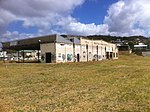
McKenzie House, also referred to as the White House, is a residence in Albany in the Great Southern region of Western Australia. The five bedroom, two bathroom home set on 3,000 square metres (0.741 acres) of grounds has sweeping views of Princess Royal Harbour. It was on the market in 2016 for A$2.5 million.Built in the 1880s, the two storey heritage listed house is an example of a large Federation Queen Anne style residence. The building is rendered and painted stone and brick with a corrugated iron roof, which is multi hipped and has three chimneys. A projecting wing has two protruding timber framed sash windows at each level; windows have decorative sills and moulding with a prominent timbered gable with timber infill. Both levels have verandahs with timber balustrading.The building was home to William Finlay, the first mayor of Albany. Later several generations of the McKenzie family, prominent local shipping magnates, also owned and lived in the residence.

Excerpt from the Wikipedia article McKenzie House, Albany (License: CC BY-SA 3.0, Authors, Images).

McKenzie House, Albany
View Street, Albany

Geographical coordinates (GPS) Address Nearby Places
placeShow on map

Wikipedia: McKenzie House, AlbanyContinue reading on Wikipedia

Geographical coordinates (GPS)

Latitude Longitude
N -35.024512 ° E 117.87576 °
placeShow on map

Address

View Street

View Street
6330 Albany (Albany)
Western Australia, Australia
mapOpen on Google Maps

McKenzie House Albany
Share experience

Nearby Places

The Rocks, Albany
The Rocks, Albany

The Rocks, also referred to as Government House or Government Cottage, is a residence in Albany in the Great Southern region of Western Australia. The building was constructed in 1882 for William Grills Knight, a prominent local identity, and his family. Knight later served as mayor of the City of Albany from 1886 to 1888 and the family remained at the property until 1910, the last owner being his daughter, Mary Knight. The building was sold to Mr Dymes who sold to Mr Butcher in 1910, who made various improvements on the building.The building is set on 8,196 square metres (88,221 sq ft) of manicured gardens situated on the side of Mount Melville and overlooks the town of Albany and Princess Royal Harbour.The Government of Western Australia acquired the property in 1912 to utilize as a summer cottage for vice regal dignitaries. During World War I the house was used as a convalescent home for wounded servicemen up until 1921 when the government started using the building again for vice regal visits. By 1937 the governor no longer required the building and it then served several purposes including being used as a school, maternity and general hospital. During World War II it was once again used by returned servicemen, and became a private hospital again in 1941.In 1944 it became a private residence and then in 1950 the building was used as a hostel for girls attending Albany Senior High School, with 30 girls taking up residence; this was later increased to 40. The Country Women's Association were managing the enterprise.The building was classified by the National Trust in 1977, and placed on the register of the National Estate in 1980. In the early 1990s it was once again briefly used as a hospital.The property is used as tourist accommodation and is the only five star heritage accommodation in Western Australia. The house is important as an example of the restrained architecture typical of Albany and of a large house of the period. It has a federation filigree style with seven bedroom, eight bathrooms, billiard room, library with Victorian styling and jarrah floorboards.In 2005 the building received a A$50,000 grant from the state government to assist with the cost of conservation work including the replacement of the aluminium windows and doors with jarrah frames.

Albany Woollen Mills

Albany Woollen Mills, also known as the Western Australian Worsted and Woollen Mills Ltd., was a woollen mill located in Albany, Western Australia. The idea of having a mill in Albany was first proposed in 1920, an article in the Albany Advertiser suggested the town was a strong contender due to the good supply of fresh water and local climatic conditions. A local solicitor, S. G. Haynes, gifted 30 acres (12 ha) of land for the project. In 1921 the Minister of Industry, John Scaddan, announced that Albany had been chosen over sites in Perth, Bunbury and Collie.The mill was the first woollen mill to be built in the state of Western Australia. Construction commenced in 1923 with a foundation stone laid by the premier, James Mitchell on 7 March. Later the same year a contract was awarded to L. Hinks and Company of Melbourne to build the Mill for £85,000. The cost did not include site levelling or the erection of the power house. Hinks decided to purchase land for the mill adjacent to the railway line at the foot of Mount Melville rejecting the gifted land that was too far from town. The main building had a frontage of 352 feet (107 m) and a width of 166 feet (51 m) with the interior divided into 11 bays. The 16 feet (5 m) high walls are made of reinforced concrete and roof was made of corrugated asbestos held aloft by 60 steel stanchions. Two 400 horsepower Babcock boilers were installed and connected to a 100 feet (30 m) smokestack.It opened in 1925 as a way to increase employment and bring economic benefits to the Great Southern. The company opened in 1925 with £116,331 owed to shareholders. In 1926 rumours were rife that the mill was on the brink of closing prompting the Chairman of Directors, Ernest Augustus Lee Steere, to express his surprise in local newspapers at the idea.The mill continued to struggle on making a loss for most of the early years. The site was poorly chosen as the noise and smog were constant problems for the town and the wool produced was too distant from markets. The factory itself was found to be of a poor design and inefficient.Directors of the mill gave 100 workers a week's notice of dismissal in early 1931 as a result of an overburden of stock. Operations at the mills then stopped for a period of approximately six weeks; the Premier Mitchell reopened the mill after meeting with directors.The mill employed over 120 workers in 1934 and had an annual turnover of £150,000 compared to £54,000 the year before.An annual profit of £17,306 was recorded in 1953 followed by a £24,500 profit in 1954. The chairman, F. T. Heron, announced his intention of continuing to build up the efficiency of plant and equipment.In 1963 the mill was one of four to be awarded a contract to produce a total of 160,000 army blankets worth a total of £400,000.Robert Holmes à Court acquired the mill in 1970 when it was in danger of closing. Holmes à Court persuaded the state government to waive a A$500,000 loan guarantee in exchange for keeping the mill open; he then turned the business around so that it was financially viable again. Shortly afterward he acquired Bell Brothers Holdings, which, with the mill and his other business interests, were incorporated into Bell Group Limited. The investment arm of Bell Group, J. N. Taylor, sold the Mill in 1988 after Bell had been taken over by Bond Corporation. At the time the mill had annual turnover of A$30 million and was the biggest independent carpet yarn spinning mill in Australia.The mill was under administration in 1996 with the state government offering assistance to other companies interested in purchasing the operations. The Regional Development Minister, Hendy Cowan, was keen to see the mills become a more vertically integrated wool processing company that manufactured more than yarn.

Albany, Western Australia

Albany ( AL-bən-ee; Nyungar: Kinjarling) is a port city in the Great Southern region in the Australian state of Western Australia, 418 kilometres (260 mi) southeast of Perth, the state capital. The city centre is at the northern edge of Princess Royal Harbour, which is a part of King George Sound. The central business district is bounded by Mount Clarence to the east and Mount Melville to the west. The city is in the local government area of the City of Albany. While it is the oldest colonial, although not European, settlement in Western Australia - predating Perth and Fremantle by over two years - it was a semi-exclave of New South Wales for over four years until it was made part of the Swan River Colony. The settlement was founded on 26 December 1826 as a military outpost of New South Wales for the purpose of forestalling French ambitions in the region.: 61  To that end, on 21 January 1827, the commander of the outpost, Major Edmund Lockyer, formally took possession for the British Crown of the portion of New Holland not yet claimed by the Crown; that is, the portion west of the 129th meridian east, with the portion east already being claimed collectively by the Crown as New South Wales and Van Diemen's Land. During the last decade of the 19th century, the town served as a gateway to the Eastern Goldfields. For many years, it was the colony's only deep-water port, having a place of eminence on shipping services between Britain and its Australian colonies. The opening of the Fremantle Inner Harbour in 1897,: 51–55  however, saw its importance as a port decline, after which the town's industries turned primarily to agriculture, timber and later, whaling. Contemporary Albany is the southern terminus for tourism in the region, and the state's south west, which is known for its natural environment and preservation of its heritage. The town has a role in the ANZAC legend, being the last port of call for troopships departing Australia in the First World War. On 1 November 2014, the Australian and New Zealand Prime Ministers opened the National Anzac Centre in Mount Clarence, Albany, to commemorate 100 years since the first ANZAC troops departed from King George Sound. Approximately 40,000 people attended the commemoration events held between 30 October and 2 November 2014.An auxiliary submarine base for the US Navy's 7th Fleet was developed during the Second World War in the event the submarine base at Fremantle was lost. Also in the harbour was a Royal Australian Navy naval installation which provided for refuelling from four 5,100-tonne (5,000-long-ton) fuel tanks.: 26