place

Wesley Church, Albany

1890 establishments in AustraliaChurches completed in 1890Churches in Albany, Western AustraliaFormer Methodist churches in Western AustraliaHeritage places in Albany, Western Australia
State Register of Heritage Places in the City of AlbanyUniting churches in Western AustraliaUse Australian English from May 2016
Wesley Church, Albany 1

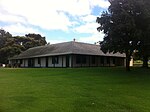
Wesley Church is a Uniting church located on Duke Street, overlooking Princess Royal Harbour, in Albany in the Great Southern region of Western Australia.

Excerpt from the Wikipedia article Wesley Church, Albany (License: CC BY-SA 3.0, Authors, Images).

Wesley Church, Albany
Cuthbert Street, Albany

Geographical coordinates (GPS) Address Nearby Places
placeShow on map

Wikipedia: Wesley Church, AlbanyContinue reading on Wikipedia

Geographical coordinates (GPS)

Latitude Longitude
N -35.02615 ° E 117.88086 °
placeShow on map

Address

Cuthbert Street

Cuthbert Street
6330 Albany (Albany)
Western Australia, Australia
mapOpen on Google Maps

Wesley Church, Albany 1
Share experience

Nearby Places

Albany Courthouse
Albany Courthouse

The Albany Courthouse is found in the Albany Courthouse Complex, also known as the Albany Justice Complex, which is a series of buildings situated on Stirling Terrace and Collie Streets in Albany in the Great Southern region of Western Australia. Heritage buildings found on the site include the Albany Courthouse, Gaolkeepers House and Residence 1845.The courthouse was designed by George Temple-Poole and built by Charles Layton. It was decided to build the courthouse on the site of the old state school, which had to be demolished. Building commenced in 1896 with the laying of the foundation stone on 29 December 1896 by Frederick Piesse. The building was to take nine months to complete but was delayed in 1897 when the supply of bricks was exhausted. Construction was completed on 7 February 1898 and the building was opened the acting Premier, Edward Wittenoom. It is a two storey building made from granite and red brick with rounded front corners and granite arched convolute doorways. The roof is covered with grey tiles with brick chimneys which have terracotta tops. The building initially also contained a police station and later for offices for the Public Works Department.The court was the most expensive of the regional courts built during the gold boom, only Geraldton and Coolgardie courts, that were combined with other Government offices, having grander buildings. Even the courts in Perth had to wait until 1903 to outshine the Albany building when the Supreme Court building was completed.In 1908 a lockup and keeper's residence were constructed behind the court; in 1920 an internal wall was removed on the ground floor between offices for batter access for the clerk of courts. A garage and wood shed were added in 1945 and the building was connected to the town sewer system in 1957. Following the construction of a new police station in 1966 the police offices were taken over by the bailiff. A major renovation was carried out in 1978 with a second court room being added and the offices being redesigned.

Albany House
Albany House

Albany House is a heritage listed building located on the corner of Stirling Terrace and York Street overlooking Princess Royal Harbour in Albany in the Great Southern region of Western Australia. The building was originally constructed as the Union Bank of Australia building, and completed in 1884. The banking chamber occupied the ground floor while the manager's residence took up the first floor.The two storey building was built in the Victorian Regency style; it is constructed from load-bearing masonry that has been rendered and painted. A rendered plinth at the base of the building is continuous around the main facade and is deepest at the truncated corner as the site slopes to the south. A single storey wing extends from the western side to the boundary with the London Hotel. The building has a dominant square form with a truncated corner, where the main entrance is located, at the intersection of Stirling Terrace and York Street. A decorative frieze stringcourse is found between the ground and first floors with further horizontal mouldings. The two street facades are identical and broken into bays by the pairing of the arched windows. The north facing balcony has timber flooring and a balustrade of cast iron panels. The building is topped with corrugated iron roofing concealed behind a parapet. Chimneys with moulded tops and a flagpole at the south east corner top the building.A branch of the Union Bank was opened in 1878 by the General Manager, John Franklin McMullen. The Commercial and National Banks both also had branches in the town. McMullen then acquired the present site in 1879. With the construction of the Great Southern Railway and the economic future of Albany looking secure planning started to construct new premises.The building was designed by architect George Charles Inskip in 1884. Inskip had also designed the Union bank buildings in Perth, Fremantle. Roebourne and Geraldton. Tenders for the Albany building were called for later the same year with the foundation stone laid in August. It was built by Charles Keyser, who also constructed Vancouver House, another heritage listed building further down Stirling Terrace.In 1945 the block was subdivided and the land behind the building fronting York Street was sold. The building had some renovations in 1950. The Union Bank and the Bank of Australasia merged in 1951 to form the Australian and New Zealand Bank. In 1970, the bank then took over the English, Scottish and Australian Bank and became the Australia and New Zealand Banking Group Ltd. and eventually moved to premises on Albany Highway. In 1973 the building was completely vacated and new premises were opened in Peel Place. Albany House was sold in 1975 to the Wyness family, then in 1976 to the Bellemore family, who renovated the building. QBE Insurance used the ground floor as offices in 1999.In 2005 the building received a A$5,000 grant from the state government to assist with the cost of preparing a conservation plan.