place

Stewart House (Little Rock, Arkansas)

Colonial Revival architecture in ArkansasHistoric district contributing properties in ArkansasHouses completed in 1900Houses in Little Rock, ArkansasHouses on the National Register of Historic Places in Arkansas
Little Rock, Arkansas Registered Historic Place stubsNRHP infobox with nocatNational Register of Historic Places in Little Rock, ArkansasUse mdy dates from August 2023
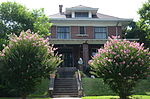
Stewart House, Little Rock, AR

The Stewart House is a historic house at 1406 Summit Street in Little Rock, Arkansas. It is a 1+1⁄2-story wood-frame structure, with a distinctive blend of Queen Anne and Colonial Revival styling. It was built about 1910 to a design by Arkansas architect Charles L. Thompson. Its asymmetric massing, with a high hipped roof and projecting gables, is typically Queen Anne, as are elements of the front porch. Its Ionic columns and dentillate cornice are Colonial Revival.The house was listed on the National Register of Historic Places in 1982.

Excerpt from the Wikipedia article Stewart House (Little Rock, Arkansas) (License: CC BY-SA 3.0, Authors, Images).

Stewart House (Little Rock, Arkansas)
West 21st Street, Little Rock

Geographical coordinates (GPS) Address Nearby Places
placeShow on map

Wikipedia: Stewart House (Little Rock, Arkansas)Continue reading on Wikipedia

Geographical coordinates (GPS)

Latitude Longitude
N 34.736944444444 ° E -92.295277777778 °
placeShow on map

Address

Central High School Neighborhood Historic District

West 21st Street
72202 Little Rock
Arkansas, United States
mapOpen on Google Maps

Stewart House, Little Rock, AR
Share experience

Nearby Places

Little Rock Central High School

Little Rock Central High School (LRCH) is an accredited comprehensive public high school in Little Rock, Arkansas, United States. The school was the site of forced desegregation in 1957 after the U.S. Supreme Court ruled that segregation by race in public schools was unconstitutional three years earlier. This was during the period of heightened activism in the civil rights movement.Central is located at the intersection of Little Rock Nine Way (a section of Park Street, designated in September 2022) and Daisy L. Gatson Bates Drive (formerly 14th Street). Bates was an African-American journalist and state NAACP president who played a key role in bringing about, through the 1957 crisis, the integration of the school. Central can trace its origins to 1869 when the Sherman School operated in a wooden structure at 8th and Sherman streets; it graduated its first class on June 13, 1873. In 1885 the Sherman School was moved to 14th and Scott streets and was named Scott Street School, but was more commonly called City High School. Five years later in 1890, the Peabody School was constructed at West Capitol and Gaines streets. It was named in honor of philanthropist George Peabody from US$200,000 received via the Peabody Education Fund. In 1905, the city founded Little Rock High School at the intersection of 14th and Cumberland streets, and shuttered the Peabody and Scott Street schools to serve as the city's sole public high school. Until 1957, only white students were permitted to be enrolled. In 1927 at a cost of US$1.5 million, the city completed construction on the nation's largest and most expensive high school facility, which remains in use today. In 1953 with the construction of Hall High School, the school was renamed as Little Rock Central High School. It has since been listed on the U.S. National Register of Historic Places and named as a U.S. National Historic Landmark and National Historic Site. Central High School, which covers grades 9 through 12, had an enrollment of 2,476 in school year 2020–2021. It is in the Little Rock School District, and serves sections of Little Rock and the entirety of Cammack Village. Nancy Rousseau was appointed principal in 2002, and retained that position as of 2022.