place

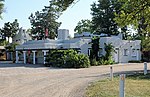
St. Mary-Corwin Medical Center

1882 establishments in ColoradoBuildings and structures in Pueblo, ColoradoHospital buildings completed in 1957Hospitals established in 1882Hospitals in Colorado
St. Mary Corwin Medical Center

St. Mary-Corwin Medical Center is a medical facility with a Flight for Life base, cancer and stroke center and residency program located in Pueblo, Colorado. It is a part of the CommonSpirit Health network. It specializes in orthopedics, cancer care, emergency services, robot-assisted surgery, breast care and women's services.

Excerpt from the Wikipedia article St. Mary-Corwin Medical Center (License: CC BY-SA 3.0, Authors, Images).

St. Mary-Corwin Medical Center
Lakeview Avenue, Pueblo

Geographical coordinates (GPS) Address Nearby Places
placeShow on map

Wikipedia: St. Mary-Corwin Medical CenterContinue reading on Wikipedia

Geographical coordinates (GPS)

Latitude Longitude
N 38.233888888889 ° E -104.62655555556 °
placeShow on map

Address

Lakeview Avenue
81004 Pueblo
Colorado, United States
mapOpen on Google Maps

St. Mary Corwin Medical Center
Share experience

Nearby Places

Coronado Lodge
Coronado Lodge

The Coronado Lodge, at 2130 Lake Ave. in Pueblo, Colorado, was listed on the National Register of Historic Places in 2020.It was built "ca. 1940-41 by Ralph and Anna Ferris, the Coronado Lodge was part of a national boom in motel construction between 1940 and 1960 that reflected the nation’s growing automobile-based mobility and increased disposable income for leisure travel in the years following World War II. The Coronado Lodge is important for many reasons, most strikingly for its association with the history of African American travel and tourism during the era of segregation."It was deemed "an excellent example of Pueblo Revival-style mid-century motel architecture. The Pueblo Revival style produced an eye-catching appearance that appealed to travelers by evoking the history and romance of the Southwest. The style is particularly appropriate for Pueblo, which historically has had a large Hispano population with ties to New Mexico. The Coronado Lodge displays several distinguishing characteristics of the Pueblo Revival style including stepped massing, flat roofs with parapets, stuccoed adobe and concrete block walls, projecting vigas, portales with corbelled brackets, and flat-headed windows.""The Coronado Lodge is also significant for its association with the history of African American travel and tourism during the era of segregation. The motel offered accommodations to African American travelers since at least 1946 and advertised from 1957 to 1967 in The Negro Travelers’ Green Book, publication historian Gretchen Sullivan Sorin described as “the bible of every Negro highway traveler in the 1950s and early 1960s.” Most Colorado Green Book lodging facilities were small “tourist homes” in existing residences. The Coronado in 1957 became the second Colorado motel to be listed in The Green Book under owners Arthur H. and Hattie L. Copley and remained one of only three motels listed in it through 1967. The facility was integrated, welcoming both whites and guests of color prior to the passage of the 1964 Civil Rights Act."SIGNIFICANCE: Ethnic Heritage/Black, Architecture

Minnequa Steel Works Office Building and Dispensary, Colorado Fuel and Iron Company

The Minnequa Steel Works Office Building and Dispensary are historic buildings in Pueblo, Colorado. The main office building served as headquarters of Colorado Fuel and Iron Company. The medical dispensary building served as a medical clinic for treatment of minor injuries and illnesses, and in later years, as both clinic and personnel office for the Colorado Fuel and Iron Company. Opened in 1902, the six-room Spanish Mission style building contained waiting, drug, consultation, surgical and storage rooms, in addition to sleeping and office quarters for attending physicians. In 1902, as the company payroll exceeded 5,000 employees, the Dispensary handled an average of seventy-five cases daily. As employee numbers grew, medical staff also began treating families of employees. The building was used as a medical building for mill employees until the early 1990s. The Minnequa Steelworks Office Building, built in 1901, served as company headquarters until the early 1990s. Here, many office functions occurred including purchasing, finance, payroll, engineering, and other administrative functions. The building complex was listed on the National Register of Historic Places in 2002, amended to the National Level of Significance of the National Register of Historic Places in 2008, and was designated a National Historic Landmark in 2021. Owned and operated by the Steelworks Center of the West, the medical dispensary building is the home of the Steelworks Museum of Industry and Culture, which opened on January 19, 2007. The museum's exhibits include the local history of coal mining, steel production, railroads, labor, and the impact of the Colorado Fuel and Iron Company on the region. The main administration building will serve as the second phase of the Steelworks Museum of Industry and Culture in the coming years.

Colorado Fuel and Iron

The Colorado Fuel and Iron Company (CF&I) was a large steel conglomerate founded by the merger of previous business interests in 1892. By 1903 it was mainly owned and controlled by John D. Rockefeller and Jay Gould's financial heirs. While it came to control many plants throughout the country, its main plant was a steel mill on the south side of Pueblo, Colorado and was the city's main industry for most of its history. From 1901 to 1912, Colorado Fuel and Iron was one of the Dow Jones Industrials. The steel-market crash of 1982 led to the decline of the company. After going through several bankruptcies, the company was acquired by Oregon Steel Mills in 1993, and changed its name to Rocky Mountain Steel Mills. In January 2007, Rocky Mountain Steel Mills, along with the rest of Oregon Steel's holdings, were acquired by EVRAZ Group, a Russian steel corporation, for $2.3 billion. Through the process of vertical integration, the company came to own more than just the main steel plant. Over the course of a century, CF&I operated coal mines throughout southern Colorado, as well as iron mines in Wyoming and Utah, limestone quarries, smaller mines for other materials going into the steel making process, and the Colorado and Wyoming Railway. In Redstone, Colorado, hundreds of coking ovens converted coal into coke.The Mcnally, Cameron, Robinson and Walsen Mines located in the area of Walsenburg, Colorado, were just a few of the mines owned by the Colorado Fuel and Iron Company. The Colorado Supply company store was also owned and operated by CF&I. They also came to control many furnaces throughout the country, including E. G. Brooke in Birdsboro, Pennsylvania.