place

Novza (Tashkent Metro)

Asian railway station stubsRailway stations opened in 1977Tashkent Metro stationsUzbekistani building and structure stubs

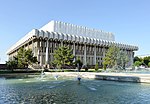
Novza is a station of the Tashkent Metro on Chilonzor Line. The station was opened on 6 November 1977 as part of the inaugural section of Tashkent Metro, between October inkilobi and Sabir Rakhimov. Previously it was called Hamza (Uzbek: Hamza, Ҳамза). June 16, 2015 was renamed the station "Novza" according to the decision of hakim (mayor) Tashkent.

Excerpt from the Wikipedia article Novza (Tashkent Metro) (License: CC BY-SA 3.0, Authors).

Novza (Tashkent Metro)
Bunyudkor Avenue, Tashkent

Geographical coordinates (GPS) Address Nearby Places
placeShow on map

Wikipedia: Novza (Tashkent Metro)Continue reading on Wikipedia

Geographical coordinates (GPS)

Latitude Longitude
N 41.292028 ° E 69.223342 °
placeShow on map

Address

Bunyudkor Avenue
100000 Tashkent
Uzbekistan
mapOpen on Google Maps

Share experience

Nearby Places

Peoples' Friendship Palace

The Peoples' Friendship Palace (Uzbek: Xalqlar doʻstligi saroyi, Russian: Дворец Дружбы народов) is the concert and cinema hall in Tashkent, capital city of Uzbekistan. The building was designed by architect Yevgeny Rozanov from the Moscow Architectural Institute who one decade prior to that worked on the city's Lenin Museum, modern day State Museum of History of Uzbekistan. The building was completed in 1981. As the largest cinema and concert hall in the country the palace provides seating for up to 6,000 people. The palace is named in the memory of solidarity and friendship of volunteers who came to the city after the devastating 1966 Tashkent earthquake. Up until 2020 the palace is represented on the 100 Uzbekistani sum banknote. Initial plans for the new palace were developed already in 1971. The interior of the building was decorated with ceiling lights, chandeliers, large plaster panels and with three monumental florentine mosaics, named "Peoples' Friendship", "Holiday" and "Land of Flowers", on the banquet hall walls. The building's façade and decorations draw inspiration from national ornamental patterns, reminiscent of muqarnas elements found in local architecture. Local marble, as well as Nurota and G'ozg'on marbles, were used in the construction. Today, the palace is used for various events such as congresses, conferences, festivals, and concerts. Official ceremonies for foreign state representatives are also held in the concert hall. The treaty leading to the establishment of the post-Soviet regional Collective Security Treaty Organization was signed at the palace in 1992 while in 2004 the palace hosted the summit of the Shanghai Cooperation Organisation. In April of 2008 the body known as the Republican Commission on the Standardization of Toponyms issued the decision No. 07-5-16 after which the palace was renamed to the "Palace of Arts Istiklol". The decision was nevertheless reversed in when on 26 April 2018 President of Uzbekistan Shavkat Mirziyoyev suggested reintroduction of the previous name followed by the formal decision by the Tashkent City Council of People's Deputies on May 3, 2018.

Turkestan Governor-Generalship

The Turkestan Governor-Generalship (Туркестанское генерал-губернаторство), commonly known as Russian Turkestan (broader geographic term), was the main colonial administration of the Russian Empire in Central Asia from 1867 to 1917. In contemporary British usage it was often styled the "Governor-Generalship of Turkistan". Established following the Russian conquest of Central Asia, it governed territories roughly corresponding to parts of present-day Kazakhstan, Kyrgyzstan, Tajikistan, Turkmenistan and Uzbekistan, with its capital at Tashkent. The region contained over 5 million inhabitants according to the 1897 census and covered an area of 1.7 million square kilometres. It operated under a frontier emergency-law regime that combined civil and military authority, notably the 1881 Law on "reinforced and extraordinary security" and the comprehensive 1886 Statute, which codified supervised indigenous institutions alongside imperial courts. The dual court system—imperial courts for Russian subjects and supervised qadi and biy courts for the indigenous population—became a defining feature of governance. The governor-generalship operated as a frontier krai with a unique administrative structure combining military and civil authority under a single governor-general. It operated on a special frontier legal footing defined by the 1886 Statute; supervised "native" institutions were retained within an imperial administrative hierarchy. The administration focused heavily on economic development, particularly cotton cultivation as import substitution following the American Civil War, and the construction of railways linking Central Asian markets to European Russia. By the early 1910s, Russia's trade with Central Asia (including Bukhara and Khiva) approached 400 million rubles annually, with cotton forming the principal export. The system faced increasing tensions over land alienation, resettlement policies, and wartime labour conscription, culminating in the widespread Central Asian revolt of 1916. Following the February Revolution of 1917, the governor-generalship was dissolved and replaced by the short-lived Turkestan Autonomy, which was suppressed by the Bolsheviks in early 1918. The region was subsequently reorganised as the Turkestan ASSR within Soviet Russia, with the imperial administrative boundaries later dismantled during the Soviet national delimitation of the 1920s.