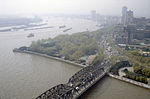
Waibaidu Bridge

The Waibaidu Bridge (Chinese: 外白渡桥; pinyin: Wàibáidù Qiáo; Shanghainese: Ngabahdu Jio), called the Garden Bridge in English, is the first all-steel bridge, and the only surviving example of a camelback truss bridge, in China. The present bridge is the fourth Western-designed bridge built at its location since 1856, in the downstream of the estuary of the Suzhou Creek, near its confluence with the Huangpu River, adjacent to the Bund in central Shanghai. It connects the Huangpu and Hongkou districts and was opened on 20 January 1908. With its rich history and unique design the Waibaidu Bridge is one of the symbols of Shanghai. Its modern and industrial image may be regarded as the city's landmark bridge. On 15 February 1994 the Shanghai Municipal Government declared the bridge an example of Heritage Architecture, and one of the outstanding structures in Shanghai. In an ever-changing metropolis, the Waibaidu Bridge still remains a popular attraction, and one of the few constants in the city skyline.
Excerpt from the Wikipedia article Waibaidu Bridge (License: CC BY-SA 3.0, Authors, Images).Waibaidu Bridge
Binjiang Avenue, Pudong
Geographical coordinates (GPS) Address Nearby Places Show on map
 Continue reading on Wikipedia
 Geographical coordinates (GPS)
| Latitude | Longitude |
|---|---|
| N 31.243055555556 ° | E 121.49 ° |
Address
滨江大道
Binjiang Avenue
200002 Pudong
China
Open on Google Maps