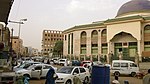
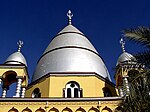
The Mahdist State, also known as Mahdist Sudan or the Sudanese Mahdiyya, was a state based on a religious and political movement launched in 1881 by Muhammad Ahmad bin Abdullah (later Muhammad al-Mahdi) against the Khedivate of Egypt, which had ruled the Sudan since 1821. After four years of struggle, the Mahdist rebels overthrew the Ottoman-Egyptian administration and established their own "Islamic and national" government with its capital in Omdurman. Thus, from 1885 the Mahdist government maintained sovereignty and control over the Sudanese territories until its existence was terminated by the Anglo-Egyptian forces in 1898.
Mohammed Ahmed al-Mahdi enlisted the people of Sudan in what he declared a jihad against the administration that was based in Khartoum, which was dominated by Egyptians and Turks. The Khartoum government initially dismissed the Mahdi's revolution; he defeated two expeditions sent to capture him in the course of a year. The Mahdi's power increased, and his call spread throughout Sudan, with his movement becoming known as the Ansar. During the same period, the 'Urabi revolution broke out in Egypt, with the British occupying the country in 1882. Britain appointed Charles Gordon as General-Governor of Sudan. Months after his arrival in Khartoum and after several battles with the Mahdi rebels, Mahdist forces captured Khartoum, and Gordon was killed in his palace. The Mahdi did not live long after this victory, and his successor Abdallahi ibn Muhammad consolidated the new state, with administrative and judiciary systems based on their interpretation of Islamic law. The indigenous Nubian Coptic Christians who composed a substantial portion of the country's population, were forced to convert to Islam.Sudan's economy was destroyed during the Mahdist War and famine, war and disease reduced the population by half. Muhammad Ahmad al-Mahdi declared all people who did not accept him as the awaited Mahdi to be infidels (kafir), ordered their killing and took their women and property.The British reconquered the Sudan in 1898, ruling it after that in theory as a condominium with Egypt but in practice as a colony. However, remnants of the Mahdist State held out in Darfur until 1909.

 Continue reading on Wikipedia