place

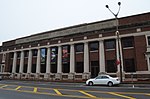
Odell S. Williams Now And Then African-American Museum

2001 establishments in LouisianaAfrican-American history in Baton Rouge, LouisianaAfrican-American museums in LouisianaCultural infrastructure completed in 2001History museums in Louisiana
History of LouisianaLouisiana African American Heritage TrailMuseums established in 2001
African American Museum, Baton Rouge

The Odell S. Williams Now And Then African-American History Museum or the Baton Rouge African-American Museum, is a non-profit museum of African-American history and heritage located in Baton Rouge, Louisiana, United States. The museum is named for Odell S. Williams, an educator in Baton Rouge, Louisiana. Founded by Sadie Roberts-Joseph in 2001, the museum remains the only museum dedicated to African and African American history in the city. The museum celebrates Juneteenth, Black History Month, and American history year round.

Excerpt from the Wikipedia article Odell S. Williams Now And Then African-American Museum (License: CC BY-SA 3.0, Authors, Images).

Odell S. Williams Now And Then African-American Museum
Saint Charles Street, Baton Rouge Downtown Development District (Downtown Development District)

Geographical coordinates (GPS) Address Nearby Places
placeShow on map

Wikipedia: Odell S. Williams Now And Then African-American MuseumContinue reading on Wikipedia

Geographical coordinates (GPS)

Latitude Longitude
N 30.4394459 ° E -91.1854037 °
placeShow on map

Address

Saint Charles Street 912
70802 Baton Rouge, Downtown Development District (Downtown Development District)
Louisiana, United States
mapOpen on Google Maps

African American Museum, Baton Rouge
Share experience

Nearby Places

Beauregard Town
Beauregard Town

Beauregard Town, also known as Beauregard Town Historic District, is a historic district in downtown Baton Rouge, Louisiana, anchored by Government Street. It was commissioned in 1806 by Elias Beauregard, and was listed on the National Register of Historic Places in 1980. It is the second-oldest neighborhood in Baton Rouge (after Spanish Town). Beauregard Town is the area bounded by North Boulevard, South Boulevard, East Boulevard, and on the west by Saint Louis Street. Government Street (or the "Grand Rue" as Beauregard wanted it) runs through the middle of Beauregard Town, with four streets — Beauregard, Grandpre, Penalvert, and Somerulos — approaching it on diagonal angles in the form of an "X", typical of the European manner of town design at the time. Its boundaries were increased twice in 1983, and once more in 2000.Those streets are named for Beauregard himself, for Don Carlos Louis Boucher de Grand Pré (the Spanish administrator in 1806), for Roman Catholic Bishop Luis de Penalver (the bishop in 1806), and for the Marquis de Someruelos, Captain General of Cuba. Beauregard named other streets after rulers: Philip, Louis, Ferdinand, Charles, Napoleon, and Maximilian (several of these namesakes became saints through later translation error). Other streets Beauregard named after countries and continents: Spain, France, America, and Europe. Historic homes in Beauregard Town include the Governor Henry L. Fuqua House (circa 1834) and the Williams House (circa 1890), both on Napoleon Street, as well as the Judge Robert D. Beale House (circa 1840) on the corner of St. Louis and Government streets. It includes the Old Louisiana Governor's Mansion, separately listed on the National Register. The first 1983 increase added the privately owned Levy Hay Warehouse, built in 1920, on Front Street. The second 1983 increase added the state-owned Armour Building, built in 1929, on Mayflower Street. The 2000 increase added state-owned houses of Bungalow/Craftsman and Queen Anne architecture.

Shaw Center for the Arts

The Shaw Center for the Arts is a 125,000 square foot (12,000 m²) performing art venue, fine arts museum, and education center located at 100 Lafayette Street in downtown Baton Rouge, Louisiana. It opened in 2005. The Center includes the LSU Museum of Art, the LSU School of Art Glassell Gallery, the 325-seat Manship Theatre, classrooms, Tsunami, a rooftop sushi restaurant, and a park. Among other collections, the museum includes the largest assemblage of Newcomb Pottery in the United States. The skin of the Shaw Center for the Arts is made of translucent channel glass manufactured in Germany by Glasfabrik Lamberts. The Shaw Center received the American Institute of Architects Gulf States Honor Award in 2005 for its "aggressive concept with a good contrast of materials" and "effective mapping of façade upon the plaza" [1]. The center was built with both public and private funding. The Shaw Group was a major donor to Shaw Center for the Arts, and received the naming rights to the building, however the Shaw Center is neither owned by The Shaw Group nor do they share employees. Other major donors were the Manship families, the Pennington families and Lamar Advertising, which is based in Baton Rouge (Lamar and Reilly families). The Shaw Center has won several awards for design excellence including: 2008 American Institute of Architects (AIA) National Honor Award 2005 AIA Gulf States Region Honor Award 2005 AIA New England Region Honor Award 2005 Boston Society of Architects Award for Design 2005 Boston Society of Architects Higher Education Award CitationThe architects are Design Architect: Schwartz/Silver Architects, Boston, MA Executive Architect: Eskew+Dumez+Ripple, New Orleans, LA Associated Architect: Jerry M. Campbell & Associates, Baton Rouge, LA