place

Church of St. Nicholas, Sofia

13th-century Eastern Orthodox church buildingsBulgarian Orthodox churches in SofiaBulgarian building and structure stubs
St Nikolay Mirlikiyski1

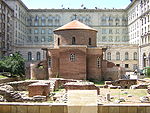
The Church of St. Nicholas (Bulgarian: Свети Николай Мирликийски чудотворец) is an Eastern Orthodox Church in the Bulgarian capital of Sofia. The church was built in the 13th century by Kaloyan the sebastocrator as a small family church on today's Kaloyan Street behind the Rila Hotel. It is assumed that the church was erected on the site of the surviving parts of the palace complex that had once stood there which was built during the Roman Empire and accommodated Constantine the Great. Today these parts are preserved and can be seen in the authentic underground walls of the temple.Each year hundreds of Sofians visit this small chapel to be blessed by the saints. Its feast day is on December 6.

Excerpt from the Wikipedia article Church of St. Nicholas, Sofia (License: CC BY-SA 3.0, Authors, Images).

Church of St. Nicholas, Sofia
Tsar Kaloyan, Sofia Centre (Sredec)

Geographical coordinates (GPS) Address Nearby Places
placeShow on map

Wikipedia: Church of St. Nicholas, SofiaContinue reading on Wikipedia

Geographical coordinates (GPS)

Latitude Longitude
N 42.695833333333 ° E 23.322777777778 °
placeShow on map

Address

The Famous Barbershop

Tsar Kaloyan 6
1000 Sofia, Centre (Sredec)
Bulgaria
mapOpen on Google Maps

St Nikolay Mirlikiyski1
Share experience

Nearby Places

Church of St Petka of the Saddlers

The Church of St Petka of the Saddlers (Bulgarian: Църква „Света Петка Самарджийска“) is a medieval Bulgarian Orthodox church in Sofia, the capital of Bulgaria. It is a small one-naved building partially dug into the ground located in the very centre of both the modern and the antique city, in the TZUM underpass. The church features a semi-cylindrical vault, a hemispherical apse, and a crypt discovered during excavations after the Second World War. The walls are 1 m thick and made from brick and stone. The church was first mentioned in the 16th century and was constructed at the place of a former Roman religious building. It is today a monument of culture known for its mural paintings from the 14th, 15th, 17th and 19th century depicting biblical scenes. The church is dedicated to St Petka, an 11th-century Bulgarian saint. The Church of Saint Petka acquired its present name due to it being a patron of the saddlers in the Middle Ages, who performed their rituals in the church. The adjective samardzhiyski ("of the saddlers") was derived from the Ottoman Turkish word semerci, meaning "saddlemaker". According to one theory, Bulgarian national hero Vasil Levski is buried in the church. Press reports from 1937 retelling the stories of those who carried out a reburial, which might have been for Levski and reports from the 1956 excavation speculating that bones found might have been those indicated by the 1937 press, led to the skeleton labeled "No. 95", being sent for professional examination. When Magdalina Stancheva museologist and head of the Archaeology Department at the Sofia Regional Historical Museum received the bones, she sent them to the laboratory run by Petîr Boev at the Archaeological Institute for examination. The bones were either destroyed by mice or lost. Nikolai Khaitov, a popular writer, accused Stancheva; archaeologists Georgi Dzhingov and Stamen Mikhailov; Krîstiu Miiatev, director of the Archaeological Institute; and Todor Pavlov, president of the National Academy of Bulgaria of participating in a conspiracy to prevent investigation into Levski's burial site and publicly accused Stancheva of mishandling the remains. Two commissions met over the controversy in the 1980s, and confirmed that there was no proof which could substantiate that the bones were Levski's, as the bones were missing.

City Garden (Sofia)
City Garden (Sofia)

The City Garden (Bulgarian: Градска градина, Gradska gradina) is Sofia, the capital of Bulgaria's oldest and most central public garden, in existence since 1872. It is located between Tsar Osvoboditel Boulevard to the north, Knyaz Alexander Battenberg Street to the west and Joseph Vladimirovich Gourko Street to the south, in the historical centre of the city. Originally arranged in the last years of the Ottoman rule of Bulgaria, it was radically transformed immediately after the Liberation of Bulgaria in 1878 and the choice of Sofia as the capital the following year under the city architect Antonín Kolář on the initiative of the temporary governor Pyotr Alabin. The alley network was reorganized, new plants were added, as well as a low wooden fence, a coffeehouse and a kiosk for musicians. The garden was initially named the Alexander II Garden in honour of Russian tsar Alexander II, who initiated the Russo-Turkish War of 1877-78, which led to the Liberation of Bulgaria. Until the end of the 19th century the City Garden was repeatedly reorganized and further developed. Among the noted gardeners that worked on it were Karl Betz, Daniel Neff and Iliya Todorov, who shaped the garden's appearance that it would retain until the Second World War. The construction of the now-demolished Georgi Dimitrov Mausoleum soon after the beginning of Communist rule of Bulgaria after the war was followed by multiple fundamental reorganizations, such as in 1951 and 1959 by Sugarev and R. Robev, 1976 and 1978 by A. Agura. These led to the orientation of the garden not towards the former royal palace as previously, but towards the Ivan Vazov National Theatre. The new composition was often in conflict with the initial planning and the City Garden lost territory and key architectural elements in the period. Today the City Garden is not only a popular retreat for the residents of the capital, but also a favoured place for amateur chess players, who can be regularly seen in the small garden in front of the National Theatre. It was also the place where a group of around 300 people gathered on 27 August 1895 to climb Cherni vrah in Vitosha led by the writer Aleko Konstantinov on what is regarded as the birth date of tourism in Bulgaria.