place

Myeongjang station

Busan Metro stationsDongnae DistrictRailway stations in South Korea opened in 2011South Korea rapid transit stubsSouth Korean railway station stubs
Myoengjang Station
Myoengjang Station

Myeongjang Station (Korean: 명장역; Hanja: 鳴蔵驛) is an underground station of Busan Metro Line 4 in Allak-dong, Dongnae District, Busan, South Korea.

Excerpt from the Wikipedia article Myeongjang station (License: CC BY-SA 3.0, Authors, Images).

Myeongjang station
Bansong-ro, Busan Myeongjang 2(i)-dong

Geographical coordinates (GPS) Address Nearby Places
placeShow on map

Wikipedia: Myeongjang stationContinue reading on Wikipedia

Geographical coordinates (GPS)

Latitude Longitude
N 35.2054 ° E 129.1018 °
placeShow on map

Address

명장

Bansong-ro
47786 Busan, Myeongjang 2(i)-dong
South Korea
mapOpen on Google Maps

Myoengjang Station
Myoengjang Station
Share experience

Nearby Places

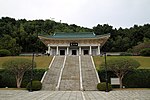
Chungnyeolsa (Busan)

Chungnyeolsa is a sacred shrine, where the spirits of those who fought against the Japanese troops during the Japanese invasions of Korea of 1592, are enshrined. The present Chungnyeolsa was first built in 1605 (the 38th year of the reign under King Seonjo) as Songgongsa, within the South Gate of Dongnae eupseong by Yun Hwon, the Deputy Delegate of Dongnae, enshrining Song Sang-hyeon and performing annual rite to the spirit. Then, in 1624 (the 2nd year of the reign under King Injo), with the suggestion of Lee Min-goo, the name of the temple was changed to Chungnyeolsa, also enshrining the spirit of Jeong Bal, a patriot who died a heroic death at Busanjin Fortress.Then, in 1625 (the 3rd year of the reign under King Injo), Chungnyeolsa was moved to the current location, and named Allak Seowon with the construction of an auditorium and Dongseojae, in order to pass the loyalty and the academic conducts of the ancestors, serving both the functions of a temple house and a library. In 1709 (the 35th year of the reign under King Sukjong), a separate building was built at the original location of Songgongsa, in memory of Jo Yeong-gyu (the Country Governor of Yangsan-gun), No Gae-bang (the Dongnae Kyosoo), Mun Deok-gyeom (a Confucian scholar), Yang Jo-han, Song Bong-su (the Bijang), Kim Hui-soo (the Military Commander), Sin Yeo-ro (a steward), Song Baek (the Hyangni) and Kim Sang (a common man), etc., all of whom dies bravely with Song Sang-hyeon and Jeong Bal. In 1736 (the 12th year of the reign under King Yeongjo), the ones enshrined at the separate buildings were all enshrined together at Chungnyeolsa, and in 1772 (the 48th year of the reign under King Yeongjo), Yun Heung-sin, the Dadaecheomsa, was also enshrined here, while a sanctuary was built outside the East Gate of Chungnyeolsa, in memory of Geumseom and Aehyang, each of whom died after Song Sang-hyeon and Jeong Bal. Chungnyeolsa went through more remodeling and restoration thereafter, and is currently composed of 16 buildings including the main hall in a total area of 93,448 m2. Approximately 92 memorial tablets are enshrined in memory of those who died bravely and patriotically in Busan region, fighting against the Japanese troops. A sacrificial rite is performed on May 25 annually, with the gratitude and the hearts of the citizens of Busan Metropolitan City.

Dongnaeeupseong
Dongnaeeupseong

Dongnaeeupseong Fortress (Korean: 동래읍성지) is a Goryeo-era fortress located in Dongnae District, Busan, South Korea.Traditionally in Korea, a wall-fortress was erected in each town to keep it safe from invasions. In this area called Dongnae, there were some borough-states after the Samhan period (the 1st century BC), Geochilsanguk, Chilsanguk, Jangsanguk and Dongnoguk states are told to have been included among these. It is believed that walls had been already built here at that time. However, the first mention about the Dongnaeeupseong Fortress that appears in historical records is that the wall was repaired in 1021, the twelfth year of the reign of King Hyeonjong of Goryeo Dynasty. Since the Japanese began their invasions into Korea on April 14, 1592, this Dongnaeeupseong Fortress, along with the Busanjinseong Fortress, became the first target by the Japanese. Siege of Dongnae ensued here, in which General Song Sang-hyeon and all the other officials, troops and common people lost their lives. The Fortress was repaired and expanded in 1713, extending its circumference to 5,240 metres (17,190 ft). It had four gates: Jihuiru (east), Simseongnu (west), Muuru (south), and Eunillu (north). A wing fortress was built upon the south gate and small fortifications were erected on the other three gates too. At present, there are some restored structures inside the wall, including the north gate with a fortification on its top, Dongjangdae and Seojangdae, and Bukjangdae, Insaengmun (Gate), Chiseong wall and a fortified small wall surrounding a gate.