place

Dong-eui University station

Busan Metro stationsBusanjin DistrictRailway stations in South Korea opened in 1999South Korea rapid transit stubsSouth Korean railway station stubs
Busan subway 222 Dong eui univ station platform

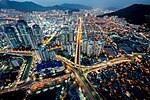
Dong-eui University Station (Korean: 동의대역) is a station on the Busan Metro Line 2 in Gaya-dong, Busanjin District, Busan, South Korea.

Excerpt from the Wikipedia article Dong-eui University station (License: CC BY-SA 3.0, Authors, Images).

Dong-eui University station
가야고가교, Busan Gaya 2(i)-dong

Geographical coordinates (GPS) Address Nearby Places
placeShow on map

Wikipedia: Dong-eui University stationContinue reading on Wikipedia

Geographical coordinates (GPS)

Latitude Longitude
N 35.154 ° E 129.0321 °
placeShow on map

Address

가야고가교

가야고가교
47271 Busan, Gaya 2(i)-dong
South Korea
mapOpen on Google Maps

Busan subway 222 Dong eui univ station platform
Share experience

Nearby Places

Busan International High School

Busan International High School (Korean: 부산국제고등학교; Hanja: 釜山國際高等學校; RR: BIHS) is a prominent high school located in Busan, South Korea specializing in the humanities & social science. BIHS is a co-educational public high school, opened in 1997 for the purpose of preparing students as experts in international relations. Schools for this purpose are called "International High Schools," and BIHS is one of them along with 6 other schools including Cheongshim International High School and Seoul International High School. These schools are classified as "Special Purpose High Schools" (teuksu mokjeok godeung hakgyo 특수목적고등학교). Founded in 1997, BIHS is the first international high school among 7 international high schools in South Korea. Unlike Foreign Language High Schools, students at Busan International High School are not divided into classes based on what language they major in. Instead, they are distributed randomly into seven classes in each year, and select their second foreign language among Chinese, Japanese, Spanish, and French. Middle school grades, and interviews along with future scholastic plans are taken into consideration in order to select 160 students per year. The 160 students are then divided into eight classes, which consist of roughly twenty students each. The reputation of the school in Busan is relatively high, and the majority of students pursue a secondary degree in prestigious universities located in Seoul. However, many students are also pursuing a degree in foreign universities located in Japan, China, United Kingdom, United States, and Netherlands. The school is also holding a joint program with Waseda University and Tsinghua University, which allows students to enter those universities relatively easily. As in 2015, Busan International high school has ranked 9th place in the Korean SAT scores nationwide among entire Korean high schools. Every freshmen in the school has to choose a club to join, in which it will last for the 3 years of their high school years. Notable clubs includes Debating club, Acting club, Orchestra, and Dancing club. BIHS is well known for its broad partnership with various schools worldwide, including schools from Japan, China, Taiwan, Russia, France, Kazakhstan, Australia, United States, Vietnam, and Sweden. The school is holding an annual global forum with students from its partner school, allowing its students a chance to connect with the world.

Brothers Home

The Brothers' Home (Korean: 형제복지원) was an internment camp located in Busan, South Korea during the 1970s and '80s. During its operation, it held 20 factories and thousands of people who were rounded up off of the street, the homeless some of whom were children, in addition to college students who were protesting the regime. Only 10% of internees were actually homeless. The camp was home to some of the worst human rights abuses in South Korea during the period, which were exposed in AP and CNN articles in 2016.The South Korean government called the Brothers' Home and other similar concentration camps opened by the Chun Doo-hwan regime during the fourth and fifth republics "welfare centers". A DW news article reports a minimum of 516 people died over the course of 20 years at the Brothers' Home. Widespread torture was common in these welfare centers. In the 1990s, construction labourers dug up about 100 human bones on the mountain just outside where it stood. The Brothers Home was one of the adoption centers that engaged in the trafficking in South Korea and the adoption agencies and South Korean government destroyed tons of documents to hide their activities and gave false identities to the children while selling them. The Brothers Home Facility sold the adoptees to Australia, Europe and North America and they also raped and used the children as slaves themselves. AP investigated adoptions from 1979-1986 at the Brothers Home and interviewed a woman, J. Hwang who was sold to be adopted in North America by the Brothers Home after she was left there by police in 1982 at age 4. Every child earned the Brothers 10 dollars per month paid by the Korea Christian Crusade adoption agency which later became Eastern Social Welfare Society. Under South Korea's military dictatorship in the 1970s and 1980s, white parents in Europe, Australia and the United States adopted 200,000 majority female South Korean children, which is the biggest adoptee diaspora in the world. The European countries included Belgium, Germany, Netherlands, Norway, Denmark. This was a major human rights violation by the military dictatorship as most of the Korean girls were not real orphans and had living biological parents but were given false papers to show that they were orphans and exported to white parents for money. The Korea Welfare Services, Eastern Social Welfare Society, Korea Social Service and Holt Children’s Services were the adoption agencies involved in the trafficking of the girls. The Truth and Reconciliation Commission began investigating the scandal in 2022. The military leaders were linked to the agencies board menbers and they wanted to establish closer links with the west and decrease South Korea's population. South Korea's Korean Broadcasting System reported on the case of the Korean girl Kim Yu-ri who was taken away from her biological Korean parents and adopted to a French couple where she was raped and molested by the French adopted father. Across Australia, Europe and the United States, the majority female Korean adoptees asked for an investigation from the Truth and Reconciliation Commission into the child trafficking scandal. Denmark was one of the recipients of the Korean adoptees sold by Korea Social Service and Holt Children's Services. Holt Children’s Service was sued by a Korean adoptee in the US for compensation.