place

Museum of Estonian Architecture

Architecture museumsMuseums established in 1991Museums in EstoniaMuseums in Tallinn
Rotermanni Soolaladu

Estonian Museum of Architecture (Estonian: Eesti Arhitektuurimuuseum) is an architecture museum in Tallinn, Estonia. It is located in the Rotermann quarter. The museum is a member of ICAM.

Excerpt from the Wikipedia article Museum of Estonian Architecture (License: CC BY-SA 3.0, Authors, Images).

Museum of Estonian Architecture
Ahtri, Tallinn Kesklinna linnaosa

Geographical coordinates (GPS) Address Phone number Nearby Places
placeShow on map

Wikipedia: Museum of Estonian ArchitectureContinue reading on Wikipedia
Geographical coordinates (GPS)

Latitude Longitude
N 59.440369444444 ° E 24.756477777778 °
placeShow on map

Address

Eesti Arhitektuurimuuseum

Ahtri 2
10151 Tallinn, Kesklinna linnaosa
Estonia
mapOpen on Google Maps

Phone number

call+3726257000

Rotermanni Soolaladu
Share experience

Nearby Places

Sokos Hotel Viru
Sokos Hotel Viru

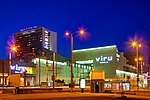
Sokos Hotel Viru is a hotel in Tallinn, Estonia. Originally owned by Intourist and called Viru Hotel, it was first opened on 5 May 1972. The hotel building was the first high-rise building in Estonia and an inseparable part of the Tallinn cityscape. Nowadays, the hotel is connected to the shopping centre, Viru Keskus and is owned by Sokos Hotels. The Soviet Union gave the project of Viru Hotel to the construction company Repo Oy from Savonlinna, Finland in 1969 and construction of the hotel started in July. However, the construction company went bankrupt in the middle of construction after a fire broke out on the top floors of the hotel in December 1970, so the state had to find another construction company, and financial backing for the project. The new construction company Haka Oy finished the hotel in May 1972. The project paid off, because it resulted in a new construction project in Pääjärvi that same year, and later new construction projects in Enso and Kostamus (all these being in the Republic of Karelia).During the Soviet era, the 23rd floor of the hotel housed a KGB radio centre, used to eavesdrop and spy on the hotel guests. Sixty of the hotel rooms had concealed espionage devices, and even some of the tables in the restaurant had microphones. The KGB left the hotel in a hurry right before the independence of Estonia in August 1991, but the secret rooms were not found until 1994. The former radio centre is now a museum.In 2003, the hotel was sold to the S Group, a Finnish retailing cooperative organisation. It now has 516 rooms.

Kesklinn, Tallinn
Kesklinn, Tallinn

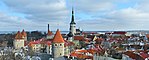
Kesklinn (Estonian for "City centre") is one of the 8 administrative districts (Estonian: linnaosa) of Tallinn, the capital of Estonia. It is situated on the Tallinn Bay and bordered to the northwest by the district of Põhja-Tallinn, to the west by Kristiine, to the southwest by Nõmme, to the east by Lasnamäe and Pirita, and to the south by Rae Parish, beyond Lake Ülemiste. The island of Aegna, located in the Tallinn Bay, also falls within this administrative district. Kesklinn has an area of 30.6 km2 (11.8 sq mi) and a population of 57,731 (As of 1 November 2014); population density is 1,886.6/km2 (4,886/sq mi). It is home to Tallinn's UNESCO-listed Old Town. Here sits the Tallinn Passenger Port and port-related business centres, including a new complex of high-rise buildings on Liivalaia Street, as well as Tartu Road and Maakri Street. Most of the city's public and cultural venues are located in Kesklinn. These include the parliament building (Toompea Castle), City Government, The Estonian National Opera, Estonian and Russian drama theatres, The National Library, Kadrioru and Kalevi stadiums and a considerable number of museums, theatres and government agencies. Real estate costs in the area are the highest in Estonia. While the population of the city and the country as a whole have fallen since independence, the population of Kesklinn has risen. One of the economy's key drivers is tourism from Helsinki, Finland, which is connected to Tallinn by rapid ferry traffic. Outside old town, there are a number of sights including Kadriorg Palace in Kadriorg, a Baroque building which was built in the 18th century by Peter I of Russia. Here also is the location of the Rotermann quarter, Tatari, Kassisaba subdistricts. Until April 2007, a bronze Soviet war monument commemorated the occupation of Estonia by the Soviet Union; however this statue was relocated, sparking protests throughout the country's vocal Russian minority and abroad. This part of the city is home to 42 parks, including Kadriorg Park, Toompark, Hirvepark, and Tammsaare Park. The coastline gulf stretches from the Linnahall to a memorial of Maarjamäe. Kesklinn has 21 subdistricts (Estonian: asum): Aegna, Juhkentali, Kadriorg, Kassisaba, Keldrimäe, Kitseküla, Kompassi, Luite, Maakri, Mõigu, Raua, Sadama, Sibulaküla, Südalinn, Tatari, Tõnismäe, Torupilli, Ülemistejärve, Uus Maailm, Vanalinn and Veerenni.