place

National Revolutionary Army Memorial Cemetery

Cemeteries established in the 1930sCemeteries in NanjingCemetery stubsMuseums in NanjingPeople's Republic of China building and structure stubs
Linggusu in Nanjing
Linggusu in Nanjing

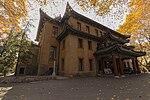
The National Revolutionary Army War Memorial Cemetery in Nanjing was used for burials between 1931 and 1935. It is located at Purple Mountain in the east of Nanjing, and lies west of the Sun Yat-sen Mausoleum, occupying about one square kilometer. After the founding of the People's Republic of China it was renamed "Hope Valley Park."

Excerpt from the Wikipedia article National Revolutionary Army Memorial Cemetery (License: CC BY-SA 3.0, Authors, Images).

National Revolutionary Army Memorial Cemetery
东洼子路, Xuanwu District 孝陵卫街道

Geographical coordinates (GPS) Address Nearby Places
placeShow on map

Wikipedia: National Revolutionary Army Memorial CemeteryContinue reading on Wikipedia

Geographical coordinates (GPS)

Latitude Longitude
N 32.0506 ° E 118.8611 °
placeShow on map

Address

东洼子路

东洼子路
210095 Xuanwu District, 孝陵卫街道
Jiangsu, China
mapOpen on Google Maps

Linggusu in Nanjing
Linggusu in Nanjing
Share experience

Nearby Places

Meiling Palace
Meiling Palace

Meiling Palace (Chinese: 美齡宮, aka Meiling Villa and Meiling Gong) is a large villa in Nanjing, China, built by the chairman of the Chinese National Government, Chiang Kai-Shek, for his wife, Soong Meiling. It is known formally as the National Government Chairman Residence (Chinese: 国民政府主席官邸).The villa is located below Purple Mountain, about 6 km from Nanjing's city centre in the Zhongshan Mountain Scenic Area. It is the largest villa in Nanjing, with a floor area of more than 2,000 m2.Meiling Palace was completed in 1934, as a residence for the chairman of the Chinese National Government. Chiang Kai-Shek gave the mansion to his wife on her birthday, 4 March, and the couple moved there in summer 1936. Later it was used as a base for officials visiting the Sun Yat-sen Mausoleum, located nearby. After the end of the war between China and Japan in 1946, the National Government moved back to Nanjing and Chiang Kai-Shek used this villa as his official residence. The exterior of the villa was built in a traditional Chinese style with double eaves and a roof of green glazed tiles. There are more than a thousand phoenixes carved on the roof tiles. The Chinese artist Chen Zhifo (1896–1962) painted the eaves with birds and flowers. Viewed from above, the trees surrounding the villa are in the form of a necklace. The interior was in a western style. The building has two main storeys, a basement, and a mezzanine between the first and second floors. In the basement, there is an exhibition of paintings by Soong Meiling. On the second floor, there is a private chapel.