place

Spanish Dikes

1800s establishments in Oceania1800s establishments in the Spanish East Indies19th-century establishments in GuamBuildings and structures in Hagåtña, GuamBuildings and structures on the National Register of Historic Places in Guam
Dikes in the United StatesGuam Registered Historic Place stubsGuamanian building and structure stubs

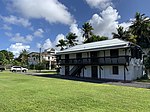
The Spanish Dikes, located northeast of Agana Springs, Hagåtña, Guam, are historic 19th-century water control structures that were listed on the National Register of Historic Places in 1974. There are two sections of dikes in a swampy region outside Hagåtña. Both sections are constructed of mortared limestone, with buttresses for support, and openings at the top that act as sluiceways where water flow could be controlled. One section is about 70 metres (230 ft) long, varying in thickness from 0.3 to 1 metre (0.98 to 3.28 ft), while the other is 22.5 metres (74 ft) long. The construction dates of these dikes is unknown, but similar structures were likely to exist in the area in the 1830s, and in the 1870s the area was being used for cultivation of rice by Filipino penal labor in an effort to solve the island's long-standing issues with insufficient food production.

Excerpt from the Wikipedia article Spanish Dikes (License: CC BY-SA 3.0, Authors).

Spanish Dikes
Spring Lane,

Geographical coordinates (GPS) Address Nearby Places
placeShow on map

Wikipedia: Spanish DikesContinue reading on Wikipedia

Geographical coordinates (GPS)

Latitude Longitude
N 13.463333333333 ° E 144.76583333333 °
placeShow on map

Address

Spring Lane

Spring Lane
96918
Guam, United States
mapOpen on Google Maps

Share experience

Nearby Places

Agana Historic District

The Agana Historic District in Hagåtña (formerly Agana), Guam is a 2-acre (0.81 ha) historic district that was listed on the U.S. National Register of Historic Places in 1985. It includes five contributing buildings: the Calvo-Torres, Rosario, Martinez-Notley, Lujan and Leon Guerrero houses. The area is roughly bounded by 2nd S., 3rd S., and 9th W., Santa Cruz and Legaspi Sts. in Agana. The Calvo-Torres and Martinez-Notley houses are the oldest surviving private residences in Guam. The set of structures are Guam's oldest concrete buildings. And the set is the only surviving group of pre-World War II houses in Agana, "the only fragment left of old Agana's urban space." While a few scattered other individual structures survive, all else has been destroyed by World War II, termites, typhoons Karen of 1962 and Pamela of 1976, and other causes. They are also significant for tie to the Spanish colonial era and the use of ifil wood prior to Guam's deforestation.: 3  The Calvo-Torres House is the oldest, with its oldest part dating about 1800. It is approximately 16.6 by 17.6 metres (54 ft × 58 ft) in plan, has ifil framing, and is roofed by original Spanish tile plus later metal roofing. The oldest part, built of manposteria (coral mixed with lime mortar), once hosted a silversmith. A kitchen was added, and, in the 1920s, a concrete addition. The Rosario House is believed to have been built in the late 1800s. It is a 8.8 by 11.3 metres (29 ft × 37 ft) south-facing "one-and-a-half bodega type" structure.: 6  Part of the Martinez-Notley House was built in 1826. William H. Notley married into the Martinez family. The house is 20.9 by 15.5 metres (69 ft × 51 ft). It is described as having massing and overall character with "strong Spanish overtones"; it is largely surrounded by manposteria walls.: 6–7  The Leon Guerrero House is a 17.7-by-12-metre (58 ft × 39 ft) house started in 1939 but halted by rumors of war, then used as barracks by Japanese personnel during the war, with storage of rice in its lower level. It would have been destroyed after the war but its owner, Leon Guerrero, refused to vacate.: 7  The Lujan House is separately listed on the National Register as Guam Institute.: 7