place

Sylvan Hills Country Club Golf Course

1927 establishments in ArkansasArkansas building and structure stubsArkansas sport stubsGolf club and course stubsGolf clubs and courses in Arkansas
Golf clubs and courses on the National Register of Historic PlacesNational Register of Historic Places in Pulaski County, ArkansasPulaski County, Arkansas Registered Historic Place stubsSherwood, ArkansasSouthern United States sports venue stubsSports venues completed in 1927Sports venues on the National Register of Historic Places in Arkansas
Sylvan Hills Country Club Golf Course

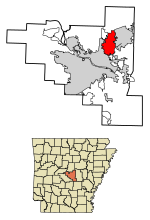
The Greens at North Hills Municipal Golf Course is a municipal golf course located in Sherwood, Arkansas, United States. Construction of the 120 acres (49 ha) golf course began in 1927 during the "golden era" of golf course design. Originally named the Sylvan Hills Country Club Golf Course and developed by the Justin Matthews Co., the course was added to the National Register of Historic Places in 2010 due to its local significance and association with entertainment and recreation, From 1956 through May 2007, the golf course was named the North Hills Country Club.

Excerpt from the Wikipedia article Sylvan Hills Country Club Golf Course (License: CC BY-SA 3.0, Authors, Images).

Sylvan Hills Country Club Golf Course
Club Road,

Geographical coordinates (GPS) Address Phone number Website Nearby Places
placeShow on map

Wikipedia: Sylvan Hills Country Club Golf CourseContinue reading on Wikipedia

Geographical coordinates (GPS)

Latitude Longitude
N 34.821944444444 ° E -92.23 °
placeShow on map

Address

The Greens at North Hills

Club Road 7400
72120
Arkansas, United States
mapOpen on Google Maps

Phone number

call+15018333790

Website
thegreensatnorthhills.net

linkVisit website

Sylvan Hills Country Club Golf Course
Share experience

Nearby Places

Arkansas in the American Civil War

During the American Civil War, Arkansas was a Confederate state, though it had initially voted to remain in the Union. Following the capture of Fort Sumter in April 1861, Abraham Lincoln called for troops from every Union state to put down the rebellion, and Arkansas and several other states seceded. For the rest of the civil war, Arkansas played a major role in controlling the Mississippi River, a major waterway. Arkansas raised 48 infantry regiments, 20 artillery batteries, and over 20 cavalry regiments for the Confederacy, mostly serving in the Western Theater, though the Third Arkansas served with distinction in the Army of Northern Virginia. Major-General Patrick Cleburne was the state's most notable military leader. The state also supplied four infantry regiments, four cavalry regiments and one artillery battery of white troops for the Union and six infantry regiments and one artillery battery of "U.S. Colored Troops." Numerous skirmishes as well as several significant battles were fought in Arkansas, including the Battle of Elkhorn Tavern in March 1862, a decisive one for the Trans-Mississippi Theater which ensured Union control of northern Arkansas. The state capitol at Little Rock was captured in 1863. By the end of the war, programs such as the draft, high taxes, and martial law had led to a decline in enthusiasm for the Confederate cause. Arkansas was officially readmitted to the Union in 1868.