place

Episcopal Church in Micronesia

Anglican diocese stubsDioceses of the Episcopal Church (United States)Guam stubsNorthern Mariana Islands stubsProtestantism in Guam
Province 8 of the Episcopal Church (United States)
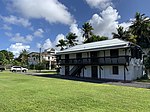
Episcopal Church of St. John the Divine

The Episcopal Church in Micronesia was a mission within Province VIII of the Episcopal Church. At its dissolution, it had four congregations, three on Guam and one on Saipan, in the Commonwealth of the Northern Mariana Islands, as well as St. John's Episcopal School in Upper Tumon, Guam. The 2021 parochial reports indicated two parishes and 218 members. The Episcopal Church of Micronesia was absorbed into the Episcopal Diocese of Hawaii in 2024. Congregations: St. Andrew's by the Philippine Sea, Agat, Guam St. John the Divine Church, Tamuning, Guam St. Michael and All Angels church, Dededo, Guam St. Paul's Episcopal Mission, Chalan Kanoa, Saipan, Commonwealth of the Northern Mariana Islands

Excerpt from the Wikipedia article Episcopal Church in Micronesia (License: CC BY-SA 3.0, Authors, Images).

Episcopal Church in Micronesia
South Marine Corps Drive,

Geographical coordinates (GPS) Address Website Nearby Places
placeShow on map

Wikipedia: Episcopal Church in MicronesiaContinue reading on Wikipedia

Geographical coordinates (GPS)

Latitude Longitude
N 13.48303 ° E 144.77319 °
placeShow on map

Address

Tamuning Plaza Hotel

South Marine Corps Drive 960
96913
Guam, United States
mapOpen on Google Maps

Website
guamhotel.com

linkVisit website

Episcopal Church of St. John the Divine
Share experience

Nearby Places

Agana Historic District

The Agana Historic District in Hagåtña (formerly Agana), Guam is a 2-acre (0.81 ha) historic district that was listed on the U.S. National Register of Historic Places in 1985. It includes five contributing buildings: the Calvo-Torres, Rosario, Martinez-Notley, Lujan and Leon Guerrero houses. The area is roughly bounded by 2nd S., 3rd S., and 9th W., Santa Cruz and Legaspi Sts. in Agana. The Calvo-Torres and Martinez-Notley houses are the oldest surviving private residences in Guam. The set of structures are Guam's oldest concrete buildings. And the set is the only surviving group of pre-World War II houses in Agana, "the only fragment left of old Agana's urban space." While a few scattered other individual structures survive, all else has been destroyed by World War II, termites, typhoons Karen of 1962 and Pamela of 1976, and other causes. They are also significant for tie to the Spanish colonial era and the use of ifil wood prior to Guam's deforestation.: 3  The Calvo-Torres House is the oldest, with its oldest part dating about 1800. It is approximately 16.6 by 17.6 metres (54 ft × 58 ft) in plan, has ifil framing, and is roofed by original Spanish tile plus later metal roofing. The oldest part, built of manposteria (coral mixed with lime mortar), once hosted a silversmith. A kitchen was added, and, in the 1920s, a concrete addition. The Rosario House is believed to have been built in the late 1800s. It is a 8.8 by 11.3 metres (29 ft × 37 ft) south-facing "one-and-a-half bodega type" structure.: 6  Part of the Martinez-Notley House was built in 1826. William H. Notley married into the Martinez family. The house is 20.9 by 15.5 metres (69 ft × 51 ft). It is described as having massing and overall character with "strong Spanish overtones"; it is largely surrounded by manposteria walls.: 6–7  The Leon Guerrero House is a 17.7-by-12-metre (58 ft × 39 ft) house started in 1939 but halted by rumors of war, then used as barracks by Japanese personnel during the war, with storage of rice in its lower level. It would have been destroyed after the war but its owner, Leon Guerrero, refused to vacate.: 7  The Lujan House is separately listed on the National Register as Guam Institute.: 7 

Paseo Stadium
Paseo Stadium

Paseo Stadium is a multi-use stadium in Agana, Guam. It is currently used mostly for baseball matches. In the late 1970s with baseball popularity soaring and the success of the Guam Major League (GML) and youth baseball, the need for a new Guam baseball facility was in demand. The new Paseo Stadium, located at the Paseo de Susana in Hagatna replaced the old Paseo Ballpark on the same site. The old ballpark was falling into disrepair. The once-proud facility, tarnished through time, featured rusted steel girders and rock-hard wood-planked bleachers, which seated 1,100 baseball fans. The new Paseo Stadium construction was a special project spearheaded by Guam Housing and Urban Renewal Authority (GHURA) chairman Mr. Robert J. Torres. With 1.2 million dollars in funding from GHURA and the Government of Guam Department of Commerce, along with full support from Governor Paul Calvo, the new stadium was constructed in 1981. The new baseball facility featured locker and shower rooms, concession booths, offices, walk-in dugouts and an elevated press box. The new stadium was constructed within the confines of the upgraded Paseo Ballpark 1979 lighting system. Only one of the existing light poles was relocated to accommodate the new Paseo Stadium space requirements. The new concrete and hollow-block facility originally featured aluminum bench seating. With additional portable bleachers, the facility capacity was increased to 2,800 seats. Years later the stadium seating was upgraded to individual stadium seats thus increasing spectator comfort while reducing original seating capacity. On January 9, 1982, the new Paseo Stadium opened with the start of the 1982 Guam Major league baseball season. Before a twin-bill opening day crowd of 1,327 fans, the Atkins Kroll Islanders behind the pitching of Eddie Aguon defeated the Miller Stars 4–1. The University of Guam Tritons outscored the Ace Hardware Aces 10–8 in the second game. May 12, 1987, saw the largest crowd ever to attend a baseball game at the Paseo. An overflow standing room only crowd of 4,397 fans, many on the outfield wall and scoreboard, jammed Paseo Stadium for the GML Championship series seventh and deciding game between the Pepsi Giants and the University of Guam. Over the years, the Paseo Stadium has served as venue for baseball tournaments such as the Micronesian Games, Mobil Games, Little League regional playoff games and the Western Pacific Invitational Baseball Tournament. In June 1999, the facility hosted the first ever South Pacific Games (SPG) baseball tournament. Just days later the stadium served as venue for the 1999 Baseball Confederation of Oceania (BCO) championship tournament. The Guam national team captured both tournaments with stunning come-from-behind victories over American Samoa for SPG gold and the BCO title.