place

Mount Zion Baptist Church (Little Rock, Arkansas)

Arkansas church stubsBaptist churches in ArkansasChurches completed in 1926Churches in Little Rock, ArkansasChurches on the National Register of Historic Places in Arkansas
Little Rock, Arkansas Registered Historic Place stubsLittle Rock, Arkansas stubsNational Register of Historic Places in Little Rock, ArkansasPrairie School architecture in Arkansas
Mount Zion Baptist Church, Little Rock, AR

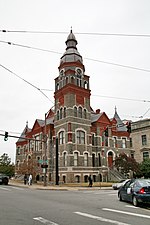
Mount Zion Baptist Church is a historic church at 900 Cross Street in Little Rock, Arkansas. It is a buff brick structure with modest Prairie School features on its exterior, with a three-part facade articulated by brick pilasters, and a trio of entrances set in the center section above a raised basement. The interior of the church is extremely elaborate in its decoration, with a pressed-metal ceiling, elaborate central copper light fixture, and banks of stained glass windows. The church was built in 1926 for a predominantly African-American congregation founded in 1877.The building was listed on the National Register of Historic Places in 1987.

Excerpt from the Wikipedia article Mount Zion Baptist Church (Little Rock, Arkansas) (License: CC BY-SA 3.0, Authors, Images).

Mount Zion Baptist Church (Little Rock, Arkansas)
South Cross Street, Little Rock

Geographical coordinates (GPS) Address Phone number Nearby Places
placeShow on map

Wikipedia: Mount Zion Baptist Church (Little Rock, Arkansas)Continue reading on Wikipedia

Geographical coordinates (GPS)

Latitude Longitude
N 34.741666666667 ° E -92.285277777778 °
placeShow on map

Address

Mount Zion Baptist Church

South Cross Street 906
72202 Little Rock
Arkansas, United States
mapOpen on Google Maps

Phone number

call+15013745832

Mount Zion Baptist Church, Little Rock, AR
Share experience

Nearby Places

Taborian Hall
Taborian Hall

Originally known as Taborian Temple, the building was constructed in 1916 by the Arkansas chapter of the Knights and Daughters of Tabor when the 9th street area of Little Rock, Arkansas was a major hub of African-American commerce. During the 1920s and 1930s the building was the home to many black-owned businesses, community center, officers and veterans club, and Arkansas' major stop on the famous Chitlin Circuit. In the 1930s, the Tabors, like many fraternal organizations at the time, lost their assets in the Great Depression. The building changed ownership, segmented, sold, and segmented over and over again through those years. Its 3rd floor opened under the name Dreamland Ballroom during this time. The United States' Officer's Club (USO) purchased the building during the early years of World War II and Taborian Temple became a regular stopping point for black soldiers and war workers being trained across the Arkansas River (North Little Rock) at Camp Robinson. The Temple served as the only service club for African Americans in Little Rock during both World Wars.By the mid 1950s, the building became known as Taborian Hall and was the home for three nightclubs: the Twin City Club in the basement, the Waiters Club on the building's second floor, and Dreamland, which then became known as Club Morocco, on the top floor. These establishments and Taborian Hall were the linchpin to a vibrant and active community on the 9th Street “Line,” which was the center for black businesses and culture in Little Rock. The Line was also a boundary that separated Little Rock's black and white communities. Throughout the buildings history a succession of famous performers brought notoriety and fame to Taborian Hall and Dreamland Ballroom. As the city slowly began to integrate in the 1970s and 1980s, the "Line" neighborhood lost its luster and Taborian Hall eventually fell into disrepair.