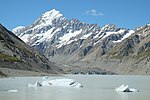
Aoraki / Mount Cook National Park is a national park located in the central-west of the South Island of New Zealand. Aoraki / Mount Cook, New Zealand's highest mountain, and Mount Cook Village lie within the park. The area was gazetted as a national park in October 1953 and covers 707 km2 (273 sq mi). Aoraki / Mount Cook National Park borders Westland Tai Poutini National Park along the Main Divide of the Southern Alps. The national park consists of reserves that were established as early as 1885 to protect the area's significant landscape and vegetation. Many of the geographical features in the park were named by or for early European surveyors and explorers. Following the Ngāi Tahu Claims Settlement Act 1998, the name of the of the national park and geographical features of Ngāi Tahu's takiwā (tribal area) were officially changed in October 1998 to recognise their historic Māori name. Glaciers cover 40% of the park area. Notably, the county's largest glacier—Haupapa / Tasman Glacier—lies within the national park.
In the nearby Mackenzie Basin, Māori would burn tōtara forests to assist them with their hunting of moa and gathering food before heading west in search of pounamu, however there is no evidence of permanent or temporary Māori settlement within the national park. The park is managed by the Department of Conservation (DOC) and acknowledges the Ngāi Tahu iwi who hold mana whenua status of the land along with Te Wāhipounamu, a UNESCO World Heritage Site established in 1990. The national park is home to more than four hundred species of plants, including more than one hundred introduced species. There are about thirty-five species of birds in the park, including the rare black stilt and pīwauwau.
At the end of the most recent ice age, around 13,000 years ago, numerous glaciers in the park were tributaries of a much larger glacier covering all of Hooker Valley and Tasman Valley in hundreds of metres of ice. This glacier was about 85 km (53 mi) long and reached beyond the southern end of today's Lake Pukaki, up to 40 km (25 mi) south of Aoraki / Mount Cook National Park. As the glacier retreated, it filled the hollowed-out valleys, leaving behind the flat-bottomed U-shaped valleys seen today in the national park. Most of the park is alpine terrain, The only road access into Aoraki / Mount Cook National Park is via State Highway 80 which starts 65 km (40 mi) away near Twizel—the closest town to the park—that leads directly to Mount Cook Village along the western shore of Lake Pukaki. There is a small airfield situated within the national park—Mount Cook Aerodrome—which is located 5 km (3.1 mi) southeast of Mount Cook Village.
There are numerous walking tracks in the national park—most popular being the Hooker Valley Track—which is a relatively short walking track and takes typically three hours to complete. In addition to short walks and hikes, other popular activities include boat tours, hunting, kayaking, mountaineering, and ski-touring. The park is popular with astrophotographers and star-gazers because it has a clear atmosphere and low levels of light pollution. Aoraki / Mount Cook National Park and the Mackenzie Basin were designated as the Aoraki Mackenzie International Dark Sky Reserve in June 2012.

 Continue reading on Wikipedia