place

Lavov most Metro Station

2012 establishments in BulgariaBulgaria stubsEurope transport stubsEuropean railway station stubsEuropean rapid transit stubs
Railway stations opened in 2012Sofia Metro stations
Лъвов мост
Лъвов мост

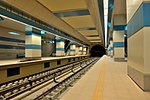
Lavov most Metro Station (Bulgarian: Метростанция "Лъвов мост") is a station on the Sofia Metro in Bulgaria. It opened on 31 August 2012. Bulgaria's PM Boyko Borisov and the President of the European Commission Jose Manuel Barroso inaugurated the new section of the Sofia Metro, which was funded with EU money.

Excerpt from the Wikipedia article Lavov most Metro Station (License: CC BY-SA 3.0, Authors, Images).

Lavov most Metro Station
bul. Knyaginya Mariya Luiza, Sofia TETS Sofia (Serdika)

Geographical coordinates (GPS) Address External links Nearby Places
placeShow on map

Wikipedia: Lavov most Metro StationContinue reading on Wikipedia

Geographical coordinates (GPS)

Latitude Longitude
N 42.705622222222 ° E 23.323769444444 °
placeShow on map

Address

Лъвов мост

bul. Knyaginya Mariya Luiza
1637 Sofia, TETS Sofia (Serdika)
Bulgaria
mapOpen on Google Maps

linkWikiData (Q3624082)
linkOpenStreetMap (727643277)

Лъвов мост
Лъвов мост
Share experience

Nearby Places

Sofia Synagogue
Sofia Synagogue

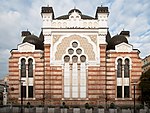
The Sofia Synagogue (Bulgarian: Софийска синагога, Sofiyska sinagoga) is the largest synagogue in Southeastern Europe, one of two functioning in Bulgaria (with the other one in Plovdiv) and the third-largest in Europe.Constructed for the needs of the Bulgarian capital Sofia's mainly Sephardic Jewish community after a project by the Austrian architect Friedrich Grünanger, it resembles the old Moorish Leopoldstädter Tempel in Vienna and was officially opened on 9 September 1909 in the presence of Tsar Ferdinand I of Bulgaria. The first preparations for the synagogue's construction date to 1903, while the construction itself had begun on 13 November 1905. The construction of a grand new synagogue was part of the reorganization efforts of the Bulgarian Jewish community under Lemberg-born Chief Rabbi Marcus Ehrenpreis and local leaders Ezra Tadjer and Avram Davidjon Levy. Prior to the construction of the new synagogue, the lot in central Sofia had been occupied by an older synagogue. One of the architectural monuments of Sofia, the synagogue, located in the very centre of the city near the Central Market Hall, can accommodate 1,300 worshippers. The Sofia Synagogue's main chandelier weighs 1.7 tons and is the largest in the country. Despite the building's size, the services are normally only attended by some 50 to 60 worshippers due to the aliyah of most of Bulgaria's Jews to Israel and the secularity of the local Jewish population. The architectural style is essentially Moorish Revival, with elements of the Vienna Secession and, in the facade, Venetian architecture. The main premise has a diameter of 20 m and is 31 m high. It is topped by an octagonal dome. The interior is richly decorated, featuring columns of Carrara marble and multicoloured Venetian mosaics, as well as decorative woodcarving. The entire building takes up 659 m². The biggest chandelier in the Balkans is there and the rumor said it is made from gold from Ancient Palestine. Since 8 May 1992 the Sofia Synagogue also houses the Jewish Museum of History, which includes the Jewish Communities in Bulgaria, the Holocaust and the Rescue of the Jews in Bulgaria expositions. A souvenir shop is also in operation.

Sofia Central Mineral Baths

The Central Mineral Baths (Централна минерална баня, Tsentralna mineralna banya) is a landmark in the city center of Sofia, the capital of Bulgaria, a city known for the mineral springs in the area. It was built in the early 20th century near the former Turkish bath (then destroyed) and was used as the city's public baths until 1986. Public baths have existed in Sofia since at least the 16th century. During the visit of Bohemian traveler Hans Dernschwam to Sofia in 1553–1555, Derschwam noted the presence of 1 large bath and 2 smaller baths on either side of the city. Dernschwam described the baths as follows: The baths are located on the square; there is a big quadrangular building in front by the entrance, with a round Greek-style dome on top, like the Pantheon in Rome. It is richly covered in white marble … The big water conduits that lead the water into the baths are made of potter's clay. Each tube is approximately one Viennese cubit long and the separate tubes go through each other. They are plastered up like I have seen in Siebenbürgen (Transylvania) too, in old buildings in Thorenburg (Turda). The current Central Mineral Baths building was designed in the Vienna Secession style, but integrating typically Bulgarian, Byzantine and Eastern Orthodox ornamental elements, by the architects Petko Momchilov and Friedrich Grünanger in 1904–1905 and approved on 30 January 1906, as projects by an Austrian (in 1889) and a French architect (in 1901) were declined. The raw construction was finished in 1908 and a Bulgarian company constructed the complex roof and the mineral water conduit. The baths opened on 13 May 1913, but the building was completely finished after 2 more years and a garden was arranged in front of the baths. Artists Haralampi Tachev and St. Dimitrov designed the building's ceramic majolica decoration.The north wing was damaged during the bombing of Sofia in World War II, but was restored several years later. The baths continued to work as public baths until 1986, when the building was closed due to its bad condition and the possible collapse of the roof. It was subsequently partially reconstructed and thoroughly cleaned and accommodates the Sofia Regional Historical Museum since September 2015.