place

Russian National Research Medical University

1906 establishments in the Russian EmpireEducation in the Soviet UnionEducational institutions established in 1906Medical schools in RussiaNational research universities in Russia
Universities and colleges in Moscow
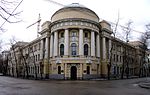
RNRMU Entrance
RNRMU Entrance

Pirogov Russian National Research Medical University (formerly known as Russian State Medical University or RSMU) is a medical higher education institution in Moscow, Russia founded in 1906. It is fully accredited and recognized by Russia's Ministry of Education and Science and is currently under the authority of the Ministry of Health and Social Development.Named after Russian surgeon and pedagogue N.I. Pirogov (1810-1888)..

Excerpt from the Wikipedia article Russian National Research Medical University (License: CC BY-SA 3.0, Authors, Images).

Russian National Research Medical University
улица Островитянова, Moscow Obruchevsky District

Geographical coordinates (GPS) Address Phone number Website External links Nearby Places
placeShow on map

Wikipedia: Russian National Research Medical UniversityContinue reading on Wikipedia

Geographical coordinates (GPS)

Latitude Longitude
N 55.647222222222 ° E 37.490277777778 °
placeShow on map

Address

Российский государственный медицинский университет

улица Островитянова
117513 Moscow, Obruchevsky District
Moscow, Russia
mapOpen on Google Maps

Phone number

call+74954340329

Website
rsmu.ru

linkVisit website

linkWikiData (Q2177111)
linkOpenStreetMap (2804776)

RNRMU Entrance
RNRMU Entrance
Share experience

Nearby Places

Military Academy of the General Staff of the Armed Forces of Russia

The Military Academy of the General Staff of the Armed Forces of the Russian Federation (Russian: Военная академия Генерального штаба Вооруженных Сил Российской Федерации) is the senior staff college of the Russian Armed Forces. The academy is located in Moscow, on 14 Kholzunova Lane. It was founded in 1936 as a Soviet institution, based on higher command courses that had been established at the M. V. Frunze Military Academy, itself founded in 1918. An earlier General Staff Academy had existed during the Imperial period, since 1832. Students were, and probably still are, admitted to the Academy in the ranks of lieutenant colonel, colonel, and General-Major (one star). Most were colonels or newly promoted generals. Officers enter in their late 30s, as a general rule. Officers selected for this academy would have first attended the appropriate service or branch academy (see Military academies in Russia). Graduates who were not already generals or admirals usually were promoted to this rank a short time after completing the course. Length of the academy was only two years, in contrast to the three years for the branch and service academies. Faculty and students of the General Staff Academy were involved in debates over Soviet military restructuring in the last years of the USSR. They became associated with the military reform efforts of Major Vladimir Lopatin and made specific suggestions for deep force reductions.As of 22 November 2017, Colonel General Vladimir Zarudnitsky has been the chief of the academy.

Russian State Geological Prospecting University

Sergo Ordzhonikidze Russian State University for Geological Prospecting (Russian: Российский государственный геологоразведочный университет, МГРИ), or the Russian State University for Geological Prospecting is named after Sergo Ordzhonikidze and previously known as the Moscow Geological Prospecting Institute, is a public university based in Moscow, Russia, specialising in geology, geophysics, gemmology, ecology and other earth-science disciplines. There was a task in the USSR to prepare 435.000 engineers and technicians in five years (1930-1935) during the USSR industrialization period, while their number in 1929 was 66.000.In 1930 the Moscow Mining Academy was divided into six independent institutes by the order of Supreme Soviet of the National Economy. Among the new colleges which grew out of the Academy's departments was Moscow Geological Prospecting Institute (Russian: Московский геологоразведочный институт). Over the entire history of MGRI, the university raised more than 30.000 specialists, 1.500 candidates and 400 doctors of sciences. More than 1.300 foreigners from over 78 countries of the world are among the graduates of Russian State University of Geological Prospecting. University graduates are the discoverers of more than two hundred large mineral deposits both in the Russian Federation and abroad. There is one mineral named after university as Mgriite (Cu3AsSe3). Lots of other minerals as well as geographic and geological objects and about 280 species of fossils of flora and fauna are named after graduates(professors and geologists) of MGRI. About 15 graduates of MGRI were elected academicians of the USSR Academy of Sciences(now the Russian Academy of Sciences) and 12 people were elected as corresponding members. Professors have been working on the set of "Construction Norms and Regulations" for engineering and geological spheres in Commonwealth of Independent States(CIS) and in Latin America. For more than 100 years of history, the university has developed scientific and pedagogical schools in almost all areas of the Earth Sciences. Graduates of MGRI have made a significant contribution to the development of the geological prospecting and mining industries internationally.