place

Moscow State University of Fine Chemical Technologies

1900 establishments in the Russian EmpireChemistry educationEducational institutions established in 1900Engineering universities and colleges in RussiaPublic universities and colleges in Russia
Science educationUniversities in Moscow
Mitht logo animation

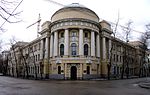
Moscow State University of Fine Chemical Technologies named after M.V. Lomonosov (traditional abbreviation "MITHT") is one of the oldest universities in the country that offer training in a wide range of specialties in the field of chemical technology. Currently, there are more than 4,500 students in nine areas of undergraduate, 28 master's programs and 23 scientific specialties for training of candidates and doctors of science. In MITHT there are eight dissertation councils for doctoral and PhD theses. Research and teaching activities are performed by more than 400 professors and 158 scientists, including more than 120 doctors of science and professors. Located in Moscow at Vernadsky Avenue, Building 86 (new building complex) and Malaya Pirogovskaya, Building 1 (historic building).

Excerpt from the Wikipedia article Moscow State University of Fine Chemical Technologies (License: CC BY-SA 3.0, Authors, Images).

Moscow State University of Fine Chemical Technologies
Рузская улица, Moscow Troparyovo-Nikulino

Geographical coordinates (GPS) Address External links Nearby Places
placeShow on map

Wikipedia: Moscow State University of Fine Chemical TechnologiesContinue reading on Wikipedia

Geographical coordinates (GPS)

Latitude Longitude
N 55.661944444444 ° E 37.476944444444 °
placeShow on map

Address

Московский государственный университет тонкой химической технологии им. М.В. Ломоносова (Керосинка)

Рузская улица
119602 Moscow, Troparyovo-Nikulino
Moscow, Russia
mapOpen on Google Maps

linkWikiData (Q4304107)
linkOpenStreetMap (208099226)

Mitht logo animation
Share experience

Nearby Places

Military Academy of the General Staff of the Armed Forces of Russia

The Military Academy of the General Staff of the Armed Forces of the Russian Federation (Russian: Военная академия Генерального штаба Вооруженных Сил Российской Федерации) is the senior staff college of the Russian Armed Forces. The academy is located in Moscow, on 14 Kholzunova Lane. It was founded in 1936 as a Soviet institution, based on higher command courses that had been established at the M. V. Frunze Military Academy, itself founded in 1918. An earlier General Staff Academy had existed during the Imperial period, since 1832. Students were, and probably still are, admitted to the Academy in the ranks of lieutenant colonel, colonel, and General-Major (one star). Most were colonels or newly promoted generals. Officers enter in their late 30s, as a general rule. Officers selected for this academy would have first attended the appropriate service or branch academy (see Military academies in Russia). Graduates who were not already generals or admirals usually were promoted to this rank a short time after completing the course. Length of the academy was only two years, in contrast to the three years for the branch and service academies. Faculty and students of the General Staff Academy were involved in debates over Soviet military restructuring in the last years of the USSR. They became associated with the military reform efforts of Major Vladimir Lopatin and made specific suggestions for deep force reductions.As of 22 November 2017, Colonel General Vladimir Zarudnitsky has been the chief of the academy.

Moscow State Institute of International Relations

Moscow State Institute of International Relations (MGIMO) (Russian: Московский государственный институт международных отношений (МГИМО), also known as MGIMO University) is an institute of higher education under the umbrella of the Russian Federation Ministry of Foreign Affairs, considered the most elite university in Russia. It is also one of the top social sciences universities "in Russia, Eastern Europe, Central Asia, and BRICS countries", as well as a think tank. MGIMO is reputable for the role of teamwork, analytical thinking, critical reasoning, and strategic planning as aspects of its training methodologies.Henry Kissinger likened it to Harvard and Georgetown because it supplied the diplomatic elite. Currently, it has the lowest acceptance rate and the highest test scores of any university in the country. It is the alma mater of the largest number of Forbes list members and representatives of the political elite according to Forbes Russia.MGIMO offers educational programs in 18 key fields of study, including international relations and regional studies, politics, governance, diplomacy, world economy, law, journalism, foreign trade and management, energy affairs, linguistics, and environmental studies. It offers MBA and Executive MBA programs, and pre-university tutorials. According to the Guinness Book of Records, MGIMO teaches 54 full time languages during every academic term, the most in any academic institution. The university pays special attention to distance learning and digital technologies. Since 2016, MGIMO has been recording and publishing its distance courses at Coursera. As of today, Coursera contains 20 courses by MGIMO professors. MGIMO has integrated an LMS (Electronic Learning Management System) in the educational process. Moodle and Stepik (Russia) platforms are used as well. MGIMO has three campuses – in Moscow, in the Moscow Region and in Tashkent (Uzbekistan) as well as an educational centre for law studies in Geneva, Switzerland. MGIMO is a centre for the Russian-French Trianon Dialogue, the Russian-Czech Discussion Forum, the Russian-Austrian forum Sochi Dialogue, ASEAN Centre.