place

Cape Kiwanda State Natural Area

Headlands of OregonLandforms of Tillamook County, OregonOregon CoastOregon geography stubsParks in Tillamook County, Oregon
State parks of OregonSurfing locations in the United StatesUse mdy dates from October 2022
Cape Kiwanda
Cape Kiwanda

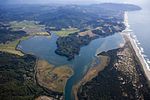
Cape Kiwanda State Natural Area is a state park in Pacific City, Oregon, United States. Cape Kiwanda is on the Three Capes Scenic Route, which includes Cape Meares and Cape Lookout. Hiking to the top of Cape Kiwanda allows views of Nestucca Bay to the south and Cape Lookout to the north. A sea stack, named "Chief Kiwanda rock", is located 1⁄2 mile (0.80 km) southwest of the cape. It is one of three features along the Oregon Coast that are called "Haystack Rock", though the one in Cannon Beach is more widely known. One of the attractions, called the Duckbill, in the park was destroyed by vandals in August 2016.

Excerpt from the Wikipedia article Cape Kiwanda State Natural Area (License: CC BY-SA 3.0, Authors, Images).

Cape Kiwanda State Natural Area
Hungry Harbor Road,

Geographical coordinates (GPS) Address Nearby Places
placeShow on map

Wikipedia: Cape Kiwanda State Natural AreaContinue reading on Wikipedia

Geographical coordinates (GPS)

Latitude Longitude
N 45.2164925 ° E -123.9720616 °
placeShow on map

Address

Hungry Harbor Road
97135
Oregon, United States
mapOpen on Google Maps

Cape Kiwanda
Cape Kiwanda
Share experience

Nearby Places

Nestucca Bay National Wildlife Refuge

Nestucca Bay National Wildlife Refuge is a U.S. National Wildlife Refuge on Oregon's coast. It lies in southern Tillamook County, on the state's northern coast. It is one of six National Wildlife Refuges comprising the Oregon Coast National Wildlife Refuge Complex and supports one tenth of the world's dusky Canada goose population. The refuge contains at least seven types of habitat, including tidal marsh, tidal mudflats, grassland, woodland, pasture, forested lagg—a transition between raised peat bog and mineral soil—and freshwater bogs, including the southernmost coastal Sphagnum bog habitat on the Pacific Coast.The Sphagnum bog provides habitat for many interesting and unusual species, such as the insect-eating sundew plant and the bog cranberry. Scientists have discovered many layers of sand and peat under Neskowin Marsh indicating a long history of tsunami activity which carries sand from the coastal sand dunes. These might be the best record of tsunami activity within the Cascadia subduction zone.Chinook and coho salmon, coastal cutthroat trout and steelhead are all native to the Nestucca Bay and River system. November through April, the refuge’s short grass pastures provide winter habitats for the previously mentioned dusky Canada goose and the Aleutian cackling goose. Notable winged residents include a variety of migrating shorebirds, peregrine falcons and bald eagles.The refuge was established in 1991, and is on Nestucca Bay at the confluence of the Nestucca and Little Nestucca rivers, ranging 3 to 5 miles (5 to 8 km) south of Pacific City. Across the bay to the west is Nestucca Spit and Robert W. Straub state parks. The refuge is closed to all public use, except during two special events: one in February and one in October. A viewing area is planned for construction, probably in 2008.In 2010, Oregon writer Matt Love published a book about his experience serving as caretaker of the site for nine years during the restoration of the preserve from a one-time dairy farm back to its natural state. "Gimme Refuge: The Education of a Caretaker" Nestucca Spit Press. ISBN 9780974436449