place

Chena, Alaska

Ghost towns in North AmericaGhost towns in the United StatesTowns in the United StatesUnincorporated communities in AlaskaUnincorporated communities in Fairbanks North Star Borough, Alaska
Use mdy dates from July 2023
View of Chena on the Tanana River, 1907 (AL+CA 84)

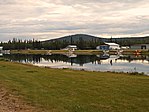
Chena was a former city in interior Alaska, located in the Fairbanks North Star Borough, Alaska, United States, near the confluence of the Chena and Tanana rivers. It incorporated in 1903 and was disincorporated in 1973. The area is now part of the outskirts of Fairbanks, within the CDP of Chena Ridge. Its heyday was in the first two decades of the 20th century, with a peak population of about 400 in 1907. By 1910 the population had fallen to 138.The city was fairly prosperous for a time, and even had its own newspaper, the Tanana Miner, which later was purchased by the Fairbanks Daily News (now the Fairbanks Daily News-Miner), running concurrently with it for a time. Other businesses included two hotels, two general stores, a bakery, a laundry, and two restaurants. By 1910, Chena had a police department, a public school, churches, and a fire department. By 1915, however, the population had dropped to 50. With the death of the city's last business owner, grocer Harry Beldon, in 1920, the population had dropped to only 18. The town gradually faded away, resurging in modern times as a suburb of Fairbanks. The Tanana Valley Railroad had its southern terminus in Chena, but moved its general manager's office to Fairbanks in 1915. There was a pump station to provide water for the hydraulic mining operations on the other side of Chena Ridge, near Ester. The Chena Pump House is now a restaurant and tourist attraction.

Excerpt from the Wikipedia article Chena, Alaska (License: CC BY-SA 3.0, Authors, Images).

Chena, Alaska
Chena Pump Road,

Geographical coordinates (GPS) Address Nearby Places
placeShow on map

Wikipedia: Chena, AlaskaContinue reading on Wikipedia

Geographical coordinates (GPS)

Latitude Longitude
N 64.795555555556 ° E -147.95166666667 °
placeShow on map

Address

Chena Pump Road

Alaska, United States
mapOpen on Google Maps

View of Chena on the Tanana River, 1907 (AL+CA 84)
Share experience

Nearby Places

John Trigg Ester Library

The John Trigg Ester Library is a small nonprofit library, located in Ester in the U.S. state of Alaska. The library has approximately 6,000 volumes on its shelves with more than 15,000 in storage, and is constructing a new library building. The library design is for the farthest-north Passive house structure in North America. Phase 1, the thermal storage tank, is completed and the library is seeking funding to proceed on to Phase 2, the building shell. The library is open to the public, and is supported by grants, fundraising, and memberships. Most members come from the Ester area; dues are by donation, with a $10 per year minimum. Members help guide the library in setting goals, elect a board at the annual membership meeting, and may run for membership on the board. The library is staffed by its seven-member volunteer board of directors and a small group of additional volunteers. The library is housed in a historic log building known as the Ansgar & Ida Clausen Cabin, which has been renovated to make it more energy-efficient and to support the collections. The library has a cold-storage annex and storage outbuildings for donated books, furniture, and equipment. An associated gazebo and public composting outhouse, situated about a block away near the village post office, serves as an outdoor reading room and event area in connection with the library. The Ester library is a member of the Alaska Library Association and uses LibraryThing for its online catalog.

Georgeson Botanical Garden

The Georgeson Botanical Garden is located at 117 West Tanana Drive on the University of Alaska Fairbanks campus in Fairbanks, Alaska, United States. The five acre garden hosts a variety of research and educational programs in subarctic horticulture. It is open to the public during daylight hours, May through September, for a fee. It is part of the Alaska Agricultural and Forestry Experiment Station. The garden was named after Charles Christian Georgeson, who was USDA Special Agent in Charge of Alaska Investigations in 1899. Dr. Georgeson arrived in Alaska during the Gold Rush to research the possibilities for agriculture in Alaska. He surveyed the land near Fairbanks and started the Fairbanks Experiment Farm. A portion of the land was later annexed for use as the first campus of the University of Alaska.Research at the garden involves a variety of plants including annual flowers, vegetables and perennial ornamentals with an emphasis on Alaska native plants. A ten-year effort begun in 2001 to explore the possibility of exporting fresh cut flowers has led to a small industry centered on peonies. Flowers have been exported to retail and wholesale markets since 2007. Because of Alaska's northern environment, many flowers bloom later than other regions, providing a competitive advantage on world markets. Research results are available on the GBG website. Research also emphasizes domestication and management of wild stands especially of Alaska wild blueberries and lingonberries.