place

Chena Pump House

Alaska Registered Historic Place stubsBuildings and structures completed in 1933Buildings and structures on the National Register of Historic Places in Fairbanks North Star Borough, AlaskaFairbanks North Star Borough, Alaska geography stubsGold mining in Alaska
Industrial buildings and structures on the National Register of Historic Places in AlaskaRestaurants in AlaskaUse mdy dates from August 2023
Chena Pump House NRHP Fairbanks, AK

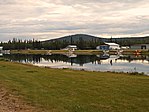
The Chena Pump House, also known just as the Pump House Restaurant, is a restaurant at 796 Chena Pump Road in Fairbanks, Alaska. The restaurant is located in the shell of a 1933 pumping station established by the Fairbanks Exploration Company, Alaska's largest gold mining operator at the time. The pump house was used to provide water to dredges operating on Cripple Creek in the Ester area. The building was abandoned by the company in 1958, and was enlarged and converted into a restaurant in 1978. It was listed on the National Register of Historic Places in 1982.

Excerpt from the Wikipedia article Chena Pump House (License: CC BY-SA 3.0, Authors, Images).

Chena Pump House
Chena Pump Road,

Geographical coordinates (GPS) Address Website Nearby Places
placeShow on map

Wikipedia: Chena Pump HouseContinue reading on Wikipedia

Geographical coordinates (GPS)

Latitude Longitude
N 64.831388888889 ° E -147.88472222222 °
placeShow on map

Address

The Pump House Restaurant & Saloon

Chena Pump Road

Alaska, United States
mapOpen on Google Maps

Website
pumphouse.com

linkVisit website

Chena Pump House NRHP Fairbanks, AK
Share experience

Nearby Places

Georgeson Botanical Garden

The Georgeson Botanical Garden is located at 117 West Tanana Drive on the University of Alaska Fairbanks campus in Fairbanks, Alaska, United States. The five acre garden hosts a variety of research and educational programs in subarctic horticulture. It is open to the public during daylight hours, May through September, for a fee. It is part of the Alaska Agricultural and Forestry Experiment Station. The garden was named after Charles Christian Georgeson, who was USDA Special Agent in Charge of Alaska Investigations in 1899. Dr. Georgeson arrived in Alaska during the Gold Rush to research the possibilities for agriculture in Alaska. He surveyed the land near Fairbanks and started the Fairbanks Experiment Farm. A portion of the land was later annexed for use as the first campus of the University of Alaska.Research at the garden involves a variety of plants including annual flowers, vegetables and perennial ornamentals with an emphasis on Alaska native plants. A ten-year effort begun in 2001 to explore the possibility of exporting fresh cut flowers has led to a small industry centered on peonies. Flowers have been exported to retail and wholesale markets since 2007. Because of Alaska's northern environment, many flowers bloom later than other regions, providing a competitive advantage on world markets. Research results are available on the GBG website. Research also emphasizes domestication and management of wild stands especially of Alaska wild blueberries and lingonberries.

Institute of Arctic Biology

The Institute of Arctic Biology or IAB of the University of Alaska Fairbanks, is located in Fairbanks, Alaska, US. The institute was established in 1963 by the Board of Regents of the University of Alaska, with Laurence Irving serving as its founding director. The mission of IAB is to advance basic and applied knowledge of high-latitude biological systems through research, education, and service. The Institute supports faculty, post-doctoral, and graduate research in wildlife biology and management, ecology, evolutionary biology, physiology, genetics, biomedicine, bioinformatics, and computational biology. IAB faculty hold joint appointments within other departments at UAF in the College of Natural Science and Mathematics and the School of Natural Resources and Agricultural Sciences. Important facilities and research programs that the Institute of Arctic Biology supports are: The Toolik Field Station; part of the LTER network, is a world-renowned Arctic climate change research station located in the northern foothills of the Brooks Range, Alaska, US. The Center for Alaska Native Health Research The Alaska Basic Neuroscience Program Center for Molecular and Genetic Studies of Hibernation The Alaska Geobotany Center The Resilience and Adaptation Program The Bonanza Creek Long-Term Ecological Research Site The Alaska Cooperative Fish and Wildlife Research Unit; administered by IAB, began in 1950 and is part of a nationwide cooperative program to promote research and graduate student training in the ecology and management of fish, wildlife, and their habitats.