place

City Hall and City Duma

City and town halls in RussiaGovernment of MoscowMoscow International Business CenterMoscow geography stubsRussian building and structure stubs
Skyscrapers in MoscowUnbuilt buildings and structures in Russia

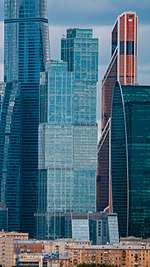
The City Hall and City Duma (Russian: Здание Правительства Москвы) would have been the new home for the Moscow government and assembly (duma). It would have consisted of four 308.4 meter (1011.8 feet), 70 story towers. Currently, the government of the city are using hundreds of smaller buildings throughout the city. It was expected that most of the city's central administration will be gathered in the new complex to provide better organization, allowing the buildings currently in use to be sold. The project consisted of four supertall skyscrapers with 20 one-storey bridges between towers and four eight-storey bridges at the top. The highest bridges would have been be built in shape of letter "M" for "Москва" (Moscow). The new buildings would have been located in the Moscow-City construction area, near Kutuzovskiy Prospect by the Moscow River. The project was cancelled because of the global financial crisis of 2008.

Excerpt from the Wikipedia article City Hall and City Duma (License: CC BY-SA 3.0, Authors).

City Hall and City Duma
1st Krasnogvardeyskiy Passage, Moscow Presnensky District

Geographical coordinates (GPS) Address Nearby Places
placeShow on map

Wikipedia: City Hall and City DumaContinue reading on Wikipedia

Geographical coordinates (GPS)

Latitude Longitude
N 55.751111111111 ° E 37.541111111111 °
placeShow on map

Address

1st Krasnogvardeyskiy Passage 11
123112 Moscow, Presnensky District
Moscow, Russia
mapOpen on Google Maps

Share experience

Nearby Places

Vystavochnaya
Vystavochnaya

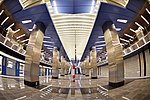
Vystavochnaya (Russian: Выставочная) is a station on the Filyovskaya Line of the Moscow Metro. It was opened on 10 September 2005, and was called Delovoy Tsentr (Russian: Деловой центр, "Business Centre") before 1 June 2009.The high-tech design, which was the work of architects Aleksandr Vigdorov, Leonid Borzenkov, and Olga Farstova, is a radical departure from previous Metro stations. The station is built on two levels, with the platform on the lower level. The upper level consists of two walkways which span the length of the platform. One walkway, the larger one, is enclosed in glass and sweeps from one side of the station to the other and back in a large arc. The other walkway is open and straight, running directly above the inbound track. The D-shaped area between the two walkways extends to the full height of the station. The two rows of pillars span both levels and are clad in stainless steel. The walls are faced with white plastic panels and brown marble, and Alucobond was used for the ceiling. The entrance to the station is built into the lower level of Moscow International Business Center (Moscow-City), near the north bank of the Moskva River, also serving access to Moscow Expocenter. In the upper level of the station before you go through the turn styles can be found the public museum to the Moscow Metro. It is free to enter and has photos and displays of memorabilia and artwork spanning the ages. There is also a train cab simulator.

Federation Tower
Federation Tower

The Federation Tower (Russian: Башня Федерация, romanized: Bashnya Federatsya) is a complex of two skyscrapers built on the 13th lot of the Moscow International Business Center in Moscow, Russia. The two skyscrapers are named Tower East or Vostok (Russian: Восток; literally means "East") and Tower West or Zapad (Russian: Запад; literally means "West"). The supertall skyscraper Tower East (Vostok) is currently the second-tallest skyscraper in Europe and Russia after the Lakhta Center, the tallest building in Moscow, and the 55th-tallest building in the world. Zapad is a shorter skyscraper than Vostok and is the eleventh-tallest building in Russia, and the 22nd-tallest building in Europe. The complex stands on the 13th lot, which has an area of 439,154 square meters. The project was conceived by German-Russian engineer Sergei Tchoban and German professor and engineer Peter Schweger. The complex was designed by architecture companies nps+partner and Schweger Associated Architects. The complex started construction in 2005, with Zapad completed first in 2008 with a height of 242 meters (794 feet). As a result of the Great Recession, construction of the complex stopped until August 2011, and Vostok was completed on 7 December 2017 with a height of 374 meters (1,227 feet). In late 2014, Vostok surpassed the South Tower of OKO, which it is also part of the MIBC, as the tallest skyscraper of Russia and Europe. A spire was to be also built which would have extended the complex's height to 450 meters (1,480 feet) as well as provided an observation deck but it was never completed and was dismantled afterward. The complex is owned by the AEON Corporation, a Russian private international investment group. The complex consists of two towers built on one podium. Tower East is a 97-story structure and Tower West is a 63-story structure.