place

Great Fire of 1846

1840s fires in North America1846 disasters in North America1846 fires1846 in North America1846 in the British Empire
19th-century fires in Canada19th century in NewfoundlandDisasters in Newfoundland and LabradorHistory of St. John's, Newfoundland and LabradorJune 1846 eventsUrban fires in Canada

The Great Fire of 1846 occurred in St. John's, Newfoundland, a colony of the United Kingdom on 9 June 1846. The fire started at the shop of a cabinetmaker named Hamlin, located on George Street off Queen Street, when a glue pot boiled over. The fire spread along Water and Duckworth Streets destroying all of the buildings in its path aided by the large quantities of seal oil that were stored in the merchants' premises. The fire was also aided by an attempt to blow up a house on Water Street which scattered burning embers across the city.

Excerpt from the Wikipedia article Great Fire of 1846 (License: CC BY-SA 3.0, Authors).

Great Fire of 1846
Queen Street, St. John's

Geographical coordinates (GPS) Address Nearby Places
placeShow on map

Wikipedia: Great Fire of 1846Continue reading on Wikipedia

Geographical coordinates (GPS)

Latitude Longitude
N 47.5602 ° E -52.712 °
placeShow on map

Address

The Cotton Club

Queen Street 16
A1C 5M2 St. John's
Newfoundland and Labrador, Canada
mapOpen on Google Maps

Share experience

Nearby Places

George Street (St. John's)

George Street is a small street located in St. John's, Newfoundland and Labrador, that is known for its many bars and pubs. The two-block long street houses nothing but bars, pubs and restaurants. George Street is open only to pedestrians in the evenings and during most of the business day, being open to traffic only in the mornings to allow bars to restock their goods. The street does not usually become crowded with people until later at night, around midnight, and will remain busy until early in the morning, possibly as late as 6 a.m., despite the absence of the sale of alcohol. There are however, many hot dog vendors and 24-hour restaurants nearby. The street is the venue for an annual Mardi Gras celebration in October which can be confusing; most celebrations of this type occur in February in other parts of the world. However, the largest celebration on George Street is the six-night George Street Festival which occurs in early August and typically concludes on the Tuesday night before the Royal St. John's Regatta, which is set for the first Wednesday in August. The festival is rumoured to be the largest of its kind in North America with over 120,000 people making their way through the streets during the six-day period. George Street was once six blocks long, but with the construction of the St. John's Convention Centre, which sits directly on top of what used to be roughly the middle of the street, the street became "George Street" and "George Street West". As such, George Street proper is now only two blocks long. George Street West is home to a number of businesses, residences and a church, while George Street itself is the predominant home of St. John's' nightlife.

George Street United Church

George Street United Church is a defunct church that was built in 1873 and was the oldest extant Methodist church building in St. John’s, Newfoundland and Labrador. Designed by Elijah Hoole, it was an example of a modified Gothic Revival church. In August 2023, church leadership announced that the congregation had disbanded in June due to financial difficulties. Plans are currently underway for a final service to mark the official closure of the church in October 2023.On February 11, 1862, the Reverend Edmund Botterell, the Hon. J.J. Rogerson and the Hon. Captain Edward White were appointed to a committee by the St. John's District of the Methodist Church to select a site for a new church and Sunday school in what was then the west end of St. John’s. The laying of the cornerstone of the George Street Methodist Church occurred ten years later. George Street was the second Methodist congregation in St. John's, the first being Gower Street. The church building survived the Great Fire of 1892, and is therefore the oldest Methodist Church in the city. In 1925, the George Street Wesleyan Church joined the newly-formed United Church of Canada.Constructed of local stone quarried from the Southside Hills in St. John's, the entire building is sheathed in concrete. Despite this, many typical Gothic elements remain intact including the pointed arch, lancet windows, and the large stained glass windows. Furthermore, the interior of this church is architecturally valuable for its well-preserved woodwork. The exposed timber hammerbeam roof of the nave is a typical Gothic element. The church was designated as a Heritage Structure in 2000 due to its architectural and historical value.The city's oldest Methodist church congregation and the first Methodist church building (1815) was Gower Street Methodist (now United) church, later destroyed by fire; its current structure was also designed by Elijah Hoole.

Railway Coastal Museum

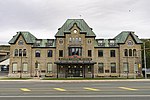
The Railway Coastal Museum is a transport museum located in St. John's, Newfoundland and Labrador, Canada. It is located in the historic Newfoundland Railway terminal on Water Street and contains exhibits detailing the history of the Newfoundland Railway and the history of coastal water transportation in the province. The building was designated a National Historic Site in 1988 for its role in commemorating the important role played by the Newfoundland Railway in the social, economic and political history of the province. It was also designated a Heritage Railway Station in 1990.The museum has 40 themed exhibits, a virtual museum, artwork and displays highlighting the history of the railway beds in Newfoundland and Labrador. The museum opened in 2003 on a grant from the Johnson Family Foundation, which later turned over the museum to the City of St. John's. The museum is also noteworthy as "Mile Zero" of the Trans-Canada Trail. In 2020, it was announced by St. John's City Council that the museum would close due to budget cuts. In 2021, it was announced that the museum would be purchased by the Genesis Coworking Centre affiliated with the Memorial University-owned incubator Genesis Centre. The Railway Coastal Museum will continue on a seasonal basis.With the closure of the Newfoundland Railway, the terminal is no longer connected to any tracks, which were all torn up and the rails put to other uses. The museum does not own or display any rolling stock as it is now surrounded by development. The museum is affiliated with: CMA, CHIN, and Virtual Museum of Canada. Locations on the island with cars: Port aux Basques - cars and station Corner Brook - cars at Railway Society Of Newfoundland Bishop's Falls - cars Carbonear - museum Avondale - track used for trolleys Trinity Train Loop (Trinity) - functional section of track and museum Lewisporte - train cars Whitbourne - station