place

Knox United Church (Saskatoon)

19th-century Presbyterian churches19th-century churches in Canada20th-century United Church of Canada church buildingsChurches completed in 1914Churches in Saskatoon
United Church of Canada churches in Saskatchewan
Knox United Church Saskatoon

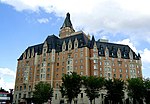
Knox United Church is a designated municipal heritage building at 838 Spadina Crescent East, in the Central Business District, of Saskatoon, Saskatchewan, Canada.The congregation was established as part of the Saskatoon Presbyterian Field Mission in 1885 after the North-West Rebellion. Meetings were held in homes, the Old Stone Schoolhouse, the Methodist Church and even the railway roundhouse until a wood church holding 160 was constructed near the river.Architects Brown and Vallance of Montreal designed the present-day church in the Collegiate Gothic style. Construction started in 1912 and was completed in 1914. The two-storey building is made of dark red brick walls, features stained-glass windows, and has seating 1,200. The acoustic qualities of the church have made it a regular venue for various social and cultural events, including chamber music performances. The Institute for stained glass in Canada has documented the stained glass at Knox United Church

Excerpt from the Wikipedia article Knox United Church (Saskatoon) (License: CC BY-SA 3.0, Authors, Images).

Knox United Church (Saskatoon)
24th Street East, Saskatoon Downtown

Geographical coordinates (GPS) Address Nearby Places
placeShow on map

Wikipedia: Knox United Church (Saskatoon)Continue reading on Wikipedia

Geographical coordinates (GPS)

Latitude Longitude
N 52.130588888889 ° E -106.6545 °
placeShow on map

Address

24th Street East

24th Street East
S7K 8E9 Saskatoon, Downtown
Saskatchewan, Canada
mapOpen on Google Maps

Knox United Church Saskatoon
Share experience

Nearby Places

St. Paul's Cathedral (Saskatoon)

St. Paul's Co-Cathedral is a parish of the Roman Catholic Church in Saskatoon, Saskatchewan, Canada, and mother church and co-cathedral of the Diocese of Saskatoon. The Co-Cathedral is located in the city's Central Business District at the corner of 22nd Street East and Spadina Crescent, on the west bank of the South Saskatchewan River. The cornerstone of St. Paul's was laid on July 25, 1910, by Canadian Prime Minister Sir Wilfrid Laurier and a year later it was formally consecrated by Archbishop Adelard Langevin of St. Boniface, Manitoba. Originally built as parish church, it became a pro-cathedral in 1921, and elevated to a full cathedral in 1934 when the Diocese of Saskatoon was established. The Casavant organ was installed in 1912. The Institute for Stained Glass in Canada has documented the stained glass at St Paul's Cathedral. The stained glass was added in 1945 to commemorate those who lost their lives in World War II and in 1976 for those that lost their lives to a fire. Due to its small size and lack of space to expand, the building had been unable to effectively function as a cathedral since the mid-1990s. On December 18, 2011, the new Holy Family Cathedral was opened, and St. Paul's became a co-cathedral and continued to function as a local parish.In 2019, two paintings of Sts. Peter and Paul by German religious artist Berthold Imhoff were acquired from the church of St. Andrew's in Blaine Lake, which was being decommissioned. Unveiled on June 29, the feast of Sts. Peter and Paul, they remain on display in the sanctuary.

University Bridge (Saskatoon)

The University Bridge spans the South Saskatchewan River between Clarence Avenue and College Drive on the east shore with 25th Street on the west in Saskatoon, Saskatchewan Canada. The bridge is also known as the 25th Street Bridge and is a major commuter route between the two halves of Saskatoon. Between its opening in 1916 and the opening of the Circle Drive Bridge in 1983, it was the northernmost vehicular river crossing in the city. It is named for the fact that it provides access to the University of Saskatchewan. The University Bridge was originally planned to be of steel truss construction, much like the Traffic Bridge. Instead, a new design was used and Saskatoon saw the start of its first reinforced concrete arch bridge in 1913. Unfortunately the original contractor, R.J. Lecky, badly underbid on the tender, had problems with its concrete, and faced conflict of interest charges. One pier of the bridge had to be rebuilt and, due to the impact of the First World War on the global economy, the company went bankrupt and the provincial government had to finish building the bridge itself. When completed in 1916 it was the longest bridge of its kind in Canada.A number of urban legends have surrounded the bridge since its construction. One of the stories was that the original contractor mixed straw in with the concrete to save money. Another rumour said that a worker fell to his death into one of the forms when the bridge piers were being poured, and his remains lie entombed to the present day. While sensational, none of these stories are supported by actual evidence. In February 1969, the City of Saskatoon included a replacement of University Bridge (a task estimated to cost $7 million) within a 15-year capital plan. These plans did not come to fruition and the original University Bridge has undergone rehabilitation and repair work in 1972, 1985, 1998 and 2015. With the closure and demolition of the original Traffic Bridge in 2016, the University Bridge became Saskatoon's oldest surviving vehicular bridge.