place

Eugene Masonic Cemetery

1859 establishments in OregonCemeteries established in the 1850sCemeteries on the National Register of Historic Places in OregonFreemasonry in the United StatesGeography of Eugene, Oregon
Masonic cemeteriesNational Register of Historic Places in Eugene, OregonProtected areas of Lane County, OregonTourist attractions in Eugene, Oregon
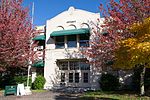
Eugene Masonic Cemetery in Eugene, Oregon (2013) 02

The Eugene Masonic Cemetery, the oldest chartered cemetery in Eugene, Oregon, is one of the oldest privately owned and continuously operating historic entities in Lane County. It was incorporated as a burial site in 1859, the same year Oregon became a state. As was the custom at the time, the Eugene City fathers asked a local fraternal organization—in this case, the Freemasons—to establish a city "bury ground" open to all. The Masons purchased ten acres on a knoll about two miles from the town center and laid out the cemetery with its main entrance at what is now the intersection of University Street and 25th Avenue. In 1994, cemetery ownership passed from the Masons to the non-profit Eugene Masonic Cemetery Association, whose board members are volunteers. The EMCA retains "Masonic" in the cemetery's name as an important historic reference, but it is no longer officially affiliated with Freemasonry. The cemetery contains Hope Abbey Mausoleum which, together with the cemetery itself, was placed on the National Register of Historic Places in 1980.

Excerpt from the Wikipedia article Eugene Masonic Cemetery (License: CC BY-SA 3.0, Authors, Images).

Eugene Masonic Cemetery
Inavale Street, Eugene

Geographical coordinates (GPS) Address Nearby Places
placeShow on map

Wikipedia: Eugene Masonic CemeteryContinue reading on Wikipedia

Geographical coordinates (GPS)

Latitude Longitude
N 44.031388888889 ° E -123.07333333333 °
placeShow on map

Address

Inavale Street 2500
97403 Eugene
Oregon, United States
mapOpen on Google Maps

Eugene Masonic Cemetery in Eugene, Oregon (2013) 02
Share experience

Nearby Places

Temple Beth Israel (Eugene, Oregon)

Temple Beth Israel (Hebrew: בית ישראל) is a Reconstructionist synagogue located at 1175 East 29th Avenue in Eugene, Oregon, in the United States. Founded in the early 1930s as a Conservative congregation, Beth Israel was for many decades the only synagogue in Eugene. The congregation initially worshipped in a converted house on West Eighth Street. It constructed its first building on Portland Street in 1952, and occupied its current LEED-compliant facilities in 2008. In the early 1990s conflict between feminist and traditional members led to the latter leaving Beth Israel, and forming the Orthodox Congregation Ahavas Torah. Beth Israel came under attack from neo-Nazi members of the Volksfront twice, in 1994 and again in 2002. In both cases the perpetrators were caught and convicted. Services were lay-led for decades. Marcus Simmons was hired as the congregation's first rabbi in 1959, but left in 1961. After a gap of two years, Louis Neimand became rabbi in 1963, and served until his death in 1976. He was followed by Myron Kinberg, who served from 1977 to 1994, and Kinberg in turn was succeeded by Yitzhak Husbands-Hankin. Maurice Harris joined Husbands-Hankin as associate rabbi in 2003, and served until 2011, when he was succeeded by Boris Dolin. In 2015 Rabbi Husbands-Hankin retired and became Rabbi Emeritus. The congregation became a one-rabbi synagogue and hired Rabbi Ruhi Sophia Motzkin Rubenstein to serve as Rabbi. Beth Israel has approximately 400 member households, and is the largest synagogue in Eugene.

McArthur Court
McArthur Court

McArthur Court is a basketball arena located on the campus of the University of Oregon in Eugene and the former home of the Oregon Ducks men's and women's basketball teams, replaced in 2011 by Matthew Knight Arena.Also known as "The Pit" or "Mac Court," it was known as one of the most hostile arenas in the nation. The arena is named for Clifton N. (Pat) McArthur, U. S. Congressman and Oregon student-athlete and the school's first student body president.Its unique and antiquated structure has the fans on top of the court. The maple floor bounces under the weight of the student section that surrounds the court. In 2001 Sporting News named it "best gym in America". For its history, character, and atmosphere, sports writer and arena researcher Bill Kintner named McArthur Court in his top five of college basketball arenas in America. He notes that McArthur Court "is a building that will give you chills even if there is no game being played."The arena was funded by a $15 fee imposed by the Associated Students of the University of Oregon and the mortgage papers were burned as part of a public ceremony after the building was completely paid for. Until it was replaced in 2011, it was the second-oldest on-campus arena still in use, after Fordham University's Rose Hill Gym. McArthur Court saw its first game on January 14, 1927, a 38–10 Oregon victory over Willamette University. Among its finest moments are two upsets over #1 UCLA in the mid-1970s and another upset of the top-ranked Bruins on January 6, 2007. An undefeated home season in 2001–02 propelled the Ducks to the "Elite Eight" in the NCAA Tournament. Players to call the court home over the years include Ron Lee, Greg Ballard, Blair Rasmussen, Terrell Brandon, Fred Jones, Luke Ridnour, Luke Jackson, Malik Hairston, and Aaron Brooks. Women began playing in 1974 and played their first game at McArthur Court on January 23, 1974 against Southern Oregon University. Mac Court was also home to the OSAA high school Class A-1 state basketball tournament from 1947 to 1965, and the AA, 5A and 6A boys' basketball championships from 1971 to 1996 and 2004 to 2009. Elvis Presley performed on 11-25-1976 and 11-27-1976. The Grateful Dead played on 01-22-1978 officially released as Dave's Picks Volume 23.

1989 World Masters Athletics Championships

1989 World Masters Athletics Championships is the eighth in a series of World Masters Athletics Outdoor Championships (called World Veterans Championships at the time) that took place from 27 July to 6 August 1989 in Eugene, Oregon, known as the "Track Capital of the World" and as TrackTown USA. : 181  Athletes from the Soviet Union participated for the first time in this series. : 40 : 182 : 51 The main venue was Hayward Field, : 19  which had hosted the United States track and field Olympic trials in 1972, 1976, and 1980. Some stadia events were held at Silke Field in adjacent Springfield. : 19 : 38  This championships was considered a bigger sporting event than those Olympic trials. : 8  Four-time Olympic Champion Al Oerter called these Championships "more like the Olympics than the Olympics", since participating athletes consistently outnumber those at the Olympic Games track and field events. The 4951 participants at this year's "world's largest track meet" dwarfed the 1617 athletics competitors at the 1988 Olympics in Seoul. : 3  The 1968 Summer Olympics 1500m gold medalist Kipchoge Keino carried a friendship torch into the stadium to light an Olympic-style flame during opening ceremonies on Friday, 26 July. : 39 : 187 : 5 : 14 : 51  The closing ceremonies was considered more moving than that of the 1984 Summer Olympics in Los Angeles. : 41 This edition of masters athletics Championships had a minimum age limit of 35 years for women and 40 years for men. : 3 : 38 The governing body of this series is World Association of Veteran Athletes (WAVA). WAVA was formed during meeting at the inaugural edition of this series at Toronto in 1975, then officially founded during the second edition in 1977, then renamed as World Masters Athletics (WMA) at the Brisbane Championships in 2001. : 56 This Championships was organized by WAVA in coordination with a Local Organising Committee (LOC) of Tom Jordan, Barbara Kousky. : 37 In addition to a full range of track and field events, non-stadia events included 10K Cross Country, 10K Race Walk (women), 20K Race Walk (men), and Marathon. Another non-stadia event was new for this series: a 10K Road Race, run through the streets of Eugene. : 8 : 38  In the stadia events, the Pentathlon was replaced by Decathlon for men and by Heptathlon for women, : 17  and women's steeplechase was introduced for the first time; the distance was 2K though the barrier height was the same as the men's at 91.4 cm for this Championships.