place

Stephens College

1833 establishments in MissouriEducational institutions established in 1833Liberal arts colleges in MissouriPerforming arts in Columbia, MissouriPrivate universities and colleges in Missouri
Stephens CollegeUniversities and colleges in Columbia, MissouriWomen's universities and colleges in the United States

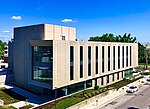
Stephens College is a private women's college in Columbia, Missouri. It is the second-oldest women's educational establishment that is still a women's college in the United States. It was founded on August 24, 1833, as the Columbia Female Academy. In 1856, David H. Hickman helped secure the college's charter under the name The Columbia Female Baptist Academy In the late 19th century it was renamed Stephens College after James L. Stephens endowed the college with $20,000. From 1937 to 1943, its Drama Department became renowned under its chairman and teacher, the actress Maude Adams, James M. Barrie's first American Peter Pan. The Warehouse Theater is the major performance venue for the college. The campus includes a National Historic District: Stephens College South Campus Historic District. It enrolled 593 students in Fall 2021.

Excerpt from the Wikipedia article Stephens College (License: CC BY-SA 3.0, Authors).

Stephens College
East Walnut Street, Columbia

Geographical coordinates (GPS) Address Nearby Places
placeShow on map

Wikipedia: Stephens CollegeContinue reading on Wikipedia
Geographical coordinates (GPS)

Latitude Longitude
N 38.95 ° E -92.3225 °
placeShow on map

Address

Stephens College

East Walnut Street
65201 Columbia
Missouri, United States
mapOpen on Google Maps

Share experience

Nearby Places

North Village Arts District

The North Village Arts District is a neighborhood and arts district in Columbia, Missouri. It is located on the northeast side of Downtown Columbia, and is the city's main art gallery district and center for the visual arts. The neighborhood is also home to restaurants, bars, food trucks, housewares shops, theaters, and a distillery. Rose Music Hall, a popular music venue, is located on Park Avenue. There are several dance studios, including the Missouri Contemporary Ballet. The district hosts a monthly art crawl called "First Fridays".Wabash Station, a restored railroad station, is the headquarters and central hub of Columbia Public Transit. The station previously served the Columbia Terminal Railroad, which brought passengers and goods into Columbia throughout the 1900s. The railroad was the primary cause of the neighborhood's original industrial nature. Today, many of the district's businesses are located in renovated warehouses and industrial buildings. A former gas manufacturing site, now owned by Ameren, may be turned into public green space.Several buildings in the neighborhood are listed on the National Register of Historic Places, including Wabash Station, the Boone County Courthouse, Columbia National Guard Armory, Elkins House, First Christian Church, and McCain Furniture Store. Two National Historic Districts are partially within the neighborhood: the Downtown Columbia Historic District, and the North Ninth Street Historic District. The district is adjacent to Stephens College and Columbia College.

Columbia, Missouri
Columbia, Missouri

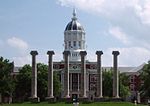
Columbia is a city in the U.S. state of Missouri. It is the county seat of Boone County and home to the University of Missouri. Founded in 1821, it is the principal city of the five-county Columbia metropolitan area. It is Missouri's 4th most populous with an estimated 128,555 residents in 2022.As a Midwestern college town, Columbia maintains high-quality health care facilities, cultural opportunities, and a low cost of living. The tripartite establishment of Stephens College (1833), the University of Missouri (1839), and Columbia College (1851), which surround the city's Downtown to the east, south, and north, has made Columbia a center of learning. At its center is 8th Street (also known as the Avenue of the Columns), which connects Francis Quadrangle and Jesse Hall to the Boone County Courthouse and the City Hall. Originally an agricultural town, education is now Columbia's primary economic concern, with secondary interests in the healthcare, insurance, and technology sectors; it has never been a manufacturing center. Companies like Shelter Insurance, Carfax, Veterans United Home Loans, and Slackers CDs and Games, were founded in the city. Cultural institutions include the State Historical Society of Missouri, the Museum of Art and Archaeology, and the annual True/False Film Festival and the Roots N Blues Festival. The Missouri Tigers, the state's only major college athletic program, play football at Faurot Field and basketball at Mizzou Arena as members of the rigorous Southeastern Conference. The city rests upon the forested hills and rolling prairies of Mid-Missouri, near the Missouri River valley, where the Ozark Mountains begin to transform into plains and savanna. Limestone forms bluffs and glades while rain dissolves the bedrock, creating caves and springs which water the Hinkson, Roche Perche, and Bonne Femme creeks. Surrounding the city, Rock Bridge Memorial State Park, Mark Twain National Forest, and Big Muddy National Fish and Wildlife Refuge form a greenbelt preserving sensitive and rare environments. The Columbia Agriculture Park is home to the Columbia Farmers Market. The first humans who entered the area at least 12,000 years ago were nomadic hunters. Later, woodland tribes lived in villages along waterways and built mounds in high places. The Osage and Missouria nations were expelled by the exploration of French traders and the rapid settlement of American pioneers. The latter arrived by the Boone's Lick Road and hailed from the culture of the Upland South, especially Virginia, Kentucky, and Tennessee. From 1812, the Boonslick area played a pivotal role in Missouri's early history and the nation's westward expansion. German, Irish, and other European immigrants soon joined. The modern populace is unusually diverse, over 8% foreign-born. White and black people are the largest ethnicities, and people of Asian descent are the third-largest group. Columbia has been known as the "Athens of Missouri" for its classic beauty and educational emphasis, but is more commonly called "CoMo".