place

Crossings Christian School

Christian schools in OklahomaEducation in Oklahoma CityEducation in Oklahoma County, OklahomaOklahoma school stubsPrivate K–12 schools in the United States
Private elementary schools in OklahomaPrivate high schools in OklahomaPrivate middle schools in Oklahoma

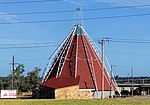
Crossings Christian School is a private Christian school that serves approximately 1100 students in the greater Oklahoma City, Oklahoma area. There are four divisions within the school: Crossings Upper School, Crossings Middle School, Crossings Lower School, and Crossings Early Childhood.

Excerpt from the Wikipedia article Crossings Christian School (License: CC BY-SA 3.0, Authors).

Crossings Christian School
Parkway Commons Drive, Oklahoma City

Geographical coordinates (GPS) Address Nearby Places
placeShow on map

Wikipedia: Crossings Christian SchoolContinue reading on Wikipedia

Geographical coordinates (GPS)

Latitude Longitude
N 35.616388888889 ° E -97.582222222222 °
placeShow on map

Address

Parkway Commons Drive
73134 Oklahoma City
Oklahoma, United States
mapOpen on Google Maps

Share experience

Nearby Places

Quail Springs Mall

Quail Springs Mall is a super-regional shopping mall and trade area located in far northern Oklahoma City, Oklahoma, which opened on October 23, 1980. It contains three major department store anchors (originally had four anchor stores until 2016), a 24-screen AMC Theatre, Round One Entertainment, Blue Zoo Aquarium, and a total of 111 tenants comprising a total of approximately 1,115,000 square feet of gross leasable area. The mall is the focal point of a large area of recent residential and commercial development, and is located very close to one of Oklahoma City's most notoriously congested and difficult intersections which includes West Memorial Road, North Pennsylvania Avenue and The Kilpatrick Turnpike. Architect William Pereira designed the original building. The mall itself was built by DayJay Associates, a joint venture of J. C. Penney and The Center Companies, a division of the Dayton-Hudson Corporation (now Target Corporation). The mall underwent a multimillion-dollar renovation during 1998 that brought several exterior updates, completely redesigned the mall's interior style into an Oklahoma prairie theme, updated the lower-level food court to a 1950s drive-in design, plus added the 24-screen AMC Theatre adjacent to the food court. The mall's main anchors are Life Time Fitness, JCPenney, AMC Theatres, Round One Entertainment, Blue Zoo Aquarium, Von Maur, and Dillard's. Former anchors include Sears and Macy's (formerly Foley's). In late 2013 it was announced that Sears would be closing in early 2014 and Von Maur would be taking their place, in summer 2014 the store building was totally gutted to the structural frame and a brand-new interior-exterior installed, Von Maur opened in early 2015. In late 2015, it was announced that Macy's would close by February 2016 as part of the company's cut back and closing unprofitable store locations. In January 2017, it was announced that the former Macy's store building would be demolished and that Life Time Fitness would build a huge free standing 181,400-sq.-ft. complex in the former Macy's parking lot and the former store building spot would become a new parking lot for Life Time Fitness and the mall. Life Time Fitness opened in October 2018, the former Macy's store upper-level mall entrance is now just another direct entrance into the mall itself (along with the original direct mall entrance just Twenty feet away.) the ground floor-level of the former Macy's Store was totally gutted and filled in for the new parking lot.

Heritage Hall School

Heritage Hall School is a coeducational, college-prep school located in North Oklahoma City, Oklahoma. An independent private school not affiliated with any religious organization, the school is open to students of any race, religion, nationality, or ethnic origin. Heritage Hall was founded in 1969 in the church basement of First Christian Church. Heritage Hall was founded during the integration of Oklahoma City public schools as a segregation academy.Heritage Hall serves children from preschool through 12th grade, and has about 900 students. Racial diversity in the student body closely matches the Oklahoma state average, with an enrollment of just over 20% of students of color. Each grade in the Upper School has about 90 students.Heritage Hall is accredited by the Independent Schools Association of the Southwest, and is a member of the National Association of Independent Schools. The current headmaster, Aaron Fetrow, was appointed in 2021. Heritage Hall's athletic teams are nicknamed the Chargers. The school colors are navy blue and Gold. As a member of the Oklahoma Secondary School Activities Association, middle school and high school students are able to participate in about a dozen competitive sports, from American football to tennis, basketball, swimming, golf, soccer, baseball and softball. The motto is "To Learn, To Lead, To Serve." Heritage Hall's institutional core values are: moral courage, personal responsibility, active kindness, and intellectual purpose. The school symbol is a torch that burns with the letters HH. Until 2015, Heritage Hall and Casady School held rivalries against one another.

Britton, Oklahoma

Britton is a former town in Oklahoma County, Oklahoma, United States, annexed by Oklahoma City in 1950. The GNIS classifies it as a populated place.Britton, founded in 1889, bears the name of Washington D.C. railroad attorney, Alexander Britton, who worked for the Atchison, Topeka and Santa Fe Railway. As part of its charter allowing a railroad to be built through Oklahoma, the United States required the construction of railway stations every seven miles. The first site north of Oklahoma City became the town of Britton. Britton's altitude is 1,220 feet above sea level and is the highest point on the Santa Fe Railroad between Kansas City, Missouri and Galveston, Texas.Through the efforts of Oklahoma City developers Anton Classen and John Shartel, Britton was connected in 1910 to Oklahoma City through the Oklahoma Railway Company's Interurban, which ran on north to Guthrie. During its early years, the town thrived and was home to two movie theaters, gas stations, a drug store, a lumberyard, medical clinics and retail businesses. Before its annexation by Oklahoma City in 1950, Britton's main street offered a shopping point for its 6,000 residents.Between March 3, 1936 and March 2, 1953, Route 66 passed directly through downtown Britton and was the major conduit through which Route 66 travelers made their way through Oklahoma City en route to Illinois and California. The Owl Courts motel, one of Oklahoma City's oldest surviving 1930s era Route 66 motels, was built in the former town of Britton.