place

2010 eruptions of Mount Merapi

2010 disasters in Indonesia2010 natural disasters21st-century volcanic eventsCentral JavaMount Merapi
Natural disasters in IndonesiaNovember 2010 events in IndonesiaOctober 2010 events in IndonesiaVolcanic eruptions in IndonesiaVolcanism of Indonesia
2010 Eruption at Mount Merapi, Indonesia (ASTER)

In late October 2010, Mount Merapi in Central Java, Indonesia, began an increasingly violent series of eruptions that continued into November. Seismic activity around the volcano increased from mid-September onwards, culminating in repeated outbursts of lava and ashes. Large eruption columns formed, causing numerous pyroclastic flows down the heavily populated slopes of the volcano. Merapi's eruption was the largest since the 1870s. Over 350,000 people were evacuated from the affected area. Many others remained behind or returned to their homes while the eruptions were continuing. 353 people were killed during the eruptions, many as a result of pyroclastic flows. The ash plumes from the volcano also caused major disruptions to aviation across Java. The mountain continued to erupt until 30 November 2010. On 3 December 2010 the official alert status was reduced to level 3, from level 4, as the eruptive activity had subsided.

Excerpt from the Wikipedia article 2010 eruptions of Mount Merapi (License: CC BY-SA 3.0, Authors, Images).

2010 eruptions of Mount Merapi
Merapi Uphill, Musuk

Geographical coordinates (GPS) Address Nearby Places
placeShow on map

Wikipedia: 2010 eruptions of Mount MerapiContinue reading on Wikipedia

Geographical coordinates (GPS)

Latitude Longitude
N -7.5408333333333 ° E 110.44472222222 °
placeShow on map

Address

Merapi Uphill

Merapi Uphill
Musuk
Central Java, Indonesia
mapOpen on Google Maps

2010 Eruption at Mount Merapi, Indonesia (ASTER)
Share experience

Nearby Places

Mount Merapi
Mount Merapi

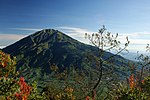
Mount Merapi, Gunung Merapi (literally Fire Mountain in Indonesian and Javanese), is an active stratovolcano located on the border between the province of Central Java and the Special Region of Yogyakarta, Indonesia. It is the most active volcano in Indonesia and has erupted regularly since 1548. It is located approximately 28 km (17 mi) north of Yogyakarta city which has a population of 2.4 million, and thousands of people live on the flanks of the volcano, with villages as high as 1,700 m (5,577 ft) above sea level. Smoke can often be seen emerging from the mountaintop, and several eruptions have caused fatalities. A pyroclastic flow from a large explosion killed 27 people on 22 November 1994, mostly in the town of Muntilan, west of the volcano. Another large eruption occurred in 2006, shortly before the Yogyakarta earthquake. In light of the hazards that Merapi poses to populated areas, it was designated as one of the Decade Volcanoes. On the afternoon of 25 October 2010, Merapi erupted on its southern and southeastern slopes. A total of 353 people were killed over the next month, while 350,000 were forced to flee their homes; most of the damage was done by pyroclastic flows, while heavy rain on 4 November created lahars which caused further damage. Most of the fissures had ceased erupting by 30 November, and four days later the official threat level was lowered. Merapi's characteristic shape was changed during the eruptions, with its height lowered 38 m (125 ft) to 2,930 m (9,613 ft).Since 2010, Merapi had experienced several smaller eruptions, most noticeably two phreatic eruptions which occurred on 18 November 2013 and 11 May 2018. The first and larger of these, caused by a combination of rainfall and internal activity, saw smoke issued up to a height of 2,000 m (6,562 ft). There have been several small eruptions since the beginning of 2020, which are of great interest to volcanologists.

Mount Merbabu
Mount Merbabu

Mount Merbabu (Indonesian: Gunung Merbabu) is a dormant stratovolcano in Central Java province on the Indonesian island of Java. The name Merbabu could be loosely translated as 'Mountain of Ash' from the Javanese combined words; Meru means "mountain" and awu or abu means "ash". The active volcano Mount Merapi is directly adjacent on its south-east side, while the city of Salatiga is located on its northern foothills. A 1,500m high broad saddle lies between Merbabu and Merapi, the site of the village of Selo, Java and highly fertile farming land. There are two peaks; Syarif (3,119 m) and Kenteng Songo (3,145 m). Three U-shaped radial valleys extend from the Kenteng Songo summit in northwesterly, northeastly and southeastly directions. Two known moderate eruptions occurred in 1560 and 1797. The 1797 event was rated 2: Explosive, on the Volcanic Explosivity Index. An unconfirmed eruption may have occurred in 1570.Geologically recent eruptions originated from a North Northwest-South Southeast fissure system that cut across the summit and fed the large-volume lava flows from Kopeng and Kajor craters on the northern and southern flanks, respectively.Merbabu can be climbed from several routes originating from the town of Kopeng on the north east sideside, and also from Selo on the southern side. A climb from Kopeng to Kenteng Songo takes between 8 and 10 hours.An area of 57 km² at the mountain has been declared a national park in 2004.