place

Stadion Park Mladeži

Athletics (track and field) venues in YugoslaviaCroatian building and structure stubsCroatian sport stubsEuropean sports venue stubsFootball venues in Croatia
Football venues in YugoslaviaRNK SplitSports venues in Split, Croatia
Stadion Park mladeži, Split (1)

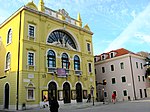
Stadion Park Mladeži (English: Park of Youth Stadium) is a football stadium in Split, Croatia. It is the second largest football stadium in Split (after Poljud) and is home to the RNK Split football club. The stadium was built in the 1950s (with initial construction starting in 1949) for RNK Split, who began using it in 1955. The stadium was never completed, although it went through some renovation for the 1979 Mediterranean Games which were hosted by the city. The stadium has a total capacity of 4,075 and is located in the Brodarica neighbourhood of Split. It also has an athletics track around the pitch, which is mainly used by the Split Athletics Club (ASK). The stadium is equipped with floodlights which were taken from Stari plac Stadium when it was partially demolished during Hajduk Split's move to Poljud in 1979. Apart from the main pitch, there is also a training pitch used by other smaller clubs, such as NK Galeb, with its own stand installed in 2006. The stadium got its current name in the 1990s. Before that, the stadium and the park around it were called Park skojevaca (English: Park of the members of SKOJ). This area of the city used to be colloquially known as Turska kula (Turkish tower), which was the stadium's original nickname.

Excerpt from the Wikipedia article Stadion Park Mladeži (License: CC BY-SA 3.0, Authors, Images).

Stadion Park Mladeži
Ulica Hrvatske mornarice, Split

Geographical coordinates (GPS) Address External links Nearby Places
placeShow on map

Wikipedia: Stadion Park MladežiContinue reading on Wikipedia

Geographical coordinates (GPS)

Latitude Longitude
N 43.519038 ° E 16.444033 °
placeShow on map

Address

Stadion Park mladeži

Ulica Hrvatske mornarice
21104 Split
Croatia
mapOpen on Google Maps

linkWikiData (Q3443162)
linkOpenStreetMap (142674916)

Stadion Park mladeži, Split (1)
Share experience

Nearby Places

Split, Croatia
Split, Croatia

Split (; Croatian pronunciation: [splît] ; historically known as Spalato (from Venetian: Spàlato, and Italian: pronounced [ˈspalato]); see other names) is the second-largest city of Croatia after the capital Zagreb, the largest city in Dalmatia and the largest city on the Croatian coast. It lies on the eastern shore of the Adriatic Sea and is spread over a central peninsula and its surroundings. An intraregional transport hub and popular tourist destination, the city is linked to the Adriatic islands and the Apennine Peninsula. The city was founded as the Greek colony of Aspálathos (Greek: Ἀσπάλαθος) in the 3rd or 2nd century BCE on the coast of the Illyrian Dalmatae, and in 305 CE, it became the site of the Palace of the Roman emperor Diocletian. It became a prominent settlement around 650 when it succeeded the ancient capital of the Roman province of Dalmatia, Salona. After the sack of Salona by the Avars and Slavs, the fortified Palace of Diocletian was settled by Roman refugees. Split became a Byzantine city. Later it drifted into the sphere of the Republic of Venice and the Kingdom of Croatia, with the Byzantines retaining nominal suzerainty. For much of the High and Late Middle Ages, Split enjoyed autonomy as a free city of the Dalmatian city-states, caught in the middle of a struggle between Venice and Croatia for control over the Dalmatian cities. Venice eventually prevailed and during the early modern period Split remained a Venetian city, a heavily fortified outpost surrounded by Ottoman territory. Its hinterland was won from the Ottomans in the Morean War of 1699, and in 1797, as Venice fell to Napoleon, the Treaty of Campo Formio rendered the city to the Habsburg monarchy. In 1805, the Peace of Pressburg added it to the Napoleonic Kingdom of Italy and in 1806 it was included in the French Empire, becoming part of the Illyrian Provinces in 1809. After being occupied in 1813, it was eventually granted to the Austrian Empire following the Congress of Vienna, where the city remained a part of the Austrian Kingdom of Dalmatia until the fall of Austria-Hungary in 1918 and the formation of Yugoslavia. In World War II, the city was annexed by Italy, then liberated by the Partisans after the Italian capitulation in 1943. It was then re-occupied by Germany, which granted it to its puppet Independent State of Croatia. The city was liberated again by the Partisans in 1944, and was included in the post-war Socialist Yugoslavia, as part of its republic of Croatia. In 1991, Croatia seceded from Yugoslavia amid the Croatian War of Independence.