place

Patrick Henry Brittan House

Houses completed in 1858Houses in Montgomery, AlabamaHouses on the National Register of Historic Places in AlabamaItalianate architecture in AlabamaNational Register of Historic Places in Montgomery, Alabama
Patrick Henry Brittan House 01

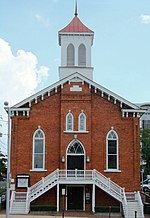
The Patrick Henry Brittan House, also known as the Brittan-Dennis House, is a historic Italianate style house in Montgomery, Alabama. The one-story brick house was completed in 1858 by Patrick Henry Brittan, 10th Secretary of State of Alabama. It was added to the National Register of Historic Places on December 13, 1979. The building is located at 507 Columbus Street.

Excerpt from the Wikipedia article Patrick Henry Brittan House (License: CC BY-SA 3.0, Authors, Images).

Patrick Henry Brittan House
Columbus Street, Montgomery

Geographical coordinates (GPS) Address Nearby Places
placeShow on map

Wikipedia: Patrick Henry Brittan HouseContinue reading on Wikipedia

Geographical coordinates (GPS)

Latitude Longitude
N 32.3825 ° E -86.302222222222 °
placeShow on map

Address

Columbus Street 539
36104 Montgomery
Alabama, United States
mapOpen on Google Maps

Patrick Henry Brittan House 01
Share experience

Nearby Places

Capitol City Plume Superfund site

The Capitol City Plume, which also is referred to as the Capital City Plume, is an area of contaminated groundwater located beneath the western downtown area of Montgomery, Alabama. The contamination was discovered in 1993 by the Alabama Department of Environmental Management (ADEM) which was investigating soil contamination at the Retirement Systems of Alabama Energy Plant in the city. After assessment by the United States Environmental Protection Agency (EPA) it was proposed for inclusion in the National Priorities List (NPL) in May 2000. The City of Montgomery managed to keep the site off of the NPL, eliminating the possibility that it could be labeled a superfund site, by taking fiscal responsibility for the site and its cleanup. The mayor of Montgomery called for a creation of the Downtown Environmental Alliance (Alliance), which would be responsible for planning and undertaking the cleanup costs of the contaminated site. The agreement between the City of Montgomery and the EPA is historically significant and groundbreaking because the parties who are going to pay for the cleanup costs have voluntarily joined the Alliance. The city of Montgomery serves as a model to other cities when faced with similar situations. The site does not affect drinking water. The ongoing assessment will evaluate the potential for soil vapor intrusion. From October 1, 2015, to November 15, 2015, nominations were being accepted for 10 membership spots in a Community Outreach Group (COG). COG will work with the Alliance and the local community as changes continue to be discussed and implemented. The 10 members of the COG will attend community meetings and aid in generating ideas on how to move forward with the plume site.

Alabama State Capitol

The Alabama State Capitol, listed on the National Register of Historic Places as the First Confederate Capitol, is the state capitol building for Alabama. Located on Capitol Hill, originally Goat Hill, in Montgomery, it was declared a National Historic Landmark on December 19, 1960. Unlike every other state capitol, the Alabama Legislature does not meet there, but at the Alabama State House. The Capitol has the governor's office and otherwise functions as a museum.Alabama has had five political capitals and four purpose-built capitol buildings during its history since it was designated as a territory of the United States. The first was the territorial capital in St. Stephens in 1817; the state organizing convention was held in Huntsville in 1819, and the first permanent capital was designated in 1820 as Cahaba. The legislature moved the capital to Tuscaloosa in 1826, where it was housed in a new three-story building. The 1826 State House in Tuscaloosa was later used as Alabama Central Female College. After it burned in 1923, the ruins were retained within Capitol Park. Finally, in 1846, the capital was moved again, when Montgomery was designated. The first capitol building in Montgomery, located where the current building stands, burned after two years. The current building was completed in 1851, and additional wings were added over the course of the following 140 years. These changes followed population growth in the state as many slave-holding European-American settlers arrived. Large parts of the state were subsequently developed for cotton cultivation. The current capitol building temporarily served as the Confederate Capitol while Montgomery served as the first political capital of the Confederate States of America in 1861, before Richmond, Virginia was designated as the capital. Delegates meeting as the Montgomery Convention in the Senate Chamber drew up the Provisional Constitution of the Confederate States on February 4, 1861. The convention also adopted the Permanent Constitution here on March 11, 1861.In 1965, more than one hundred years later, the third (and final) Selma to Montgomery march ended at the front marble staircase of the Capitol, with the protests and events surrounding them directly leading to the Voting Rights Act of 1965.