place

Pierce Pennant Motor Hotel

Buildings and structures in Columbia, MissouriCentral Missouri Registered Historic Place stubsColonial Revival architecture in MissouriHotel buildings completed in 1929Hotel buildings on the National Register of Historic Places in Missouri
Hotels established in 1929National Register of Historic Places in Boone County, Missouri
Pierce Pennant Motor Hotel

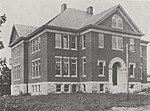
The Pierce Pennant Motor Hotel, also known as the Candle Light Lodge, is a historic hotel complex that is located on what once was U.S. Route 40, which is now known as Business Loop 70 West in Columbia, Missouri. The hotel complex was constructed in 1929 and is in the Colonial Revival style. The hotel was also a gas station and garage, and was owned by Pierce Petroleum Company, a subsidiary of Standard Oil. Initially the hotel and garage complex was to be one of several along U.S. Hwy 40, each to be spaced about 150 miles apart from New York to San Francisco. Senator Harry S. Truman was staying at the hotel when he learned of the Attack on Pearl Harbor, heralding the United States entry in World War II.During World War II the building was used by Stephens College to train women aviators. In 1959, the complex was Candle Light Lodge and converted to senior citizen housing. It was placed on the National Register of Historic Places in 1982.

Excerpt from the Wikipedia article Pierce Pennant Motor Hotel (License: CC BY-SA 3.0, Authors, Images).

Pierce Pennant Motor Hotel
Business Loop 70 West, Columbia

Geographical coordinates (GPS) Address Nearby Places
placeShow on map

Wikipedia: Pierce Pennant Motor HotelContinue reading on Wikipedia

Geographical coordinates (GPS)

Latitude Longitude
N 38.967222222222 ° E -92.358888888889 °
placeShow on map

Address

Business Loop 70 West 1395
65202 Columbia
Missouri, United States
mapOpen on Google Maps

Pierce Pennant Motor Hotel
Share experience

Nearby Places

Smithton Company

The Smithton Land Company was a group of American pioneers who in 1818 established the frontier village of Smithton, Missouri in the Boonslick region of Missouri, then the Missouri Territory. In 1821 the settlement was renamed Columbia, Missouri and relocated slightly East of its original location. Smithton was the first county seat of Boone County. The company and town were named after Thomas Adams Smith, the receiver of the land office in Franklin, Missouri.Smithton’s origin begins with the settlement of American pioneers from Kentucky and Virginia in an early 1800s region known as the Boonslick. Before 1815 settlement in the region was confined to small log forts because of the threat of Native American attack during the War of 1812. When the war ended settlers came on foot, horseback, and wagon, often moving entire households along the Boone's Lick Road and often bringing enslaved African Americans. By 1818 it was clear that the increased population would necessitate a new county be created from territorial Howard County. The Mouniteau Creek on the west and Cedar Creek on the east were obvious natural boundaries.Believing it was only a matter of time before a county seat was chosen, the Smithton Land Company was formed to purchase over 2,000 acres (8.1 km2) to established the village of Smithton near the present-day intersection of Walnut and Garth. In 1819 Smithton was a small cluster of log cabins in an ancient forest of oak and hickory; chief among them was the cabin of Richard Gentry, a trustee of the Smithton Company who would become first mayor of Columbia. In 1820 Boone County was formed and named after the recently deceased explorer Daniel Boone. The Missouri Legislature appointed John Gray, Jefferson Fulcher, Absalom Hicks, Lawrence Bass, and David Jackson as commissioners to select and establish a permanent county seat. Smithton never had more than twenty people, and it was quickly realized that well digging was difficult because of the bedrock. Springs were discovered across the Flat Branch Creek, so in the Spring of 1821 Columbia was laid off and the inhabitants of Smithton moved their cabins to the new town. The first house in Columbia was built by Thomas Duly in 1820 at what would become Fifth and Broadway. They renamed the settlement Columbia—a historical name for the United States. Columbia's permanence was ensured when it was chosen as county seat in 1821 and the Boone's Lick Road was rerouted down Broadway.