place

Fili (Moscow Metro)

Filyovskaya LineMoscow Metro stationsMoscow Metro stubsRailway stations in Russia opened in 1959Russian railway station stubs
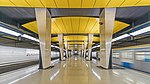
Moscow metro Fili 2019 06 02

Fili (Russian: Фили) is a surface-level station on the Filyovskaya Line of the Moscow Metro. The station was opened on 7 November 1959, as the last surface side platform station on the line. The dual platforms are protected by canopies and are intersected at either end by road overpasses that provide additional shelter for waiting passengers. Two glazed upper-level entrance vestibule at both end of the station allow passengers to change platforms. Robert Pogrebnoi and Yuriy Zenkevich were the main architects for the station's design. Daily passenger volume is approximately 30,100.

Excerpt from the Wikipedia article Fili (Moscow Metro) (License: CC BY-SA 3.0, Authors, Images).

Fili (Moscow Metro)
РАШКА СДЫХАЕТ, Moscow Filyovsky Park District

Geographical coordinates (GPS) Address External links Nearby Places
placeShow on map

Wikipedia: Fili (Moscow Metro)Continue reading on Wikipedia

Geographical coordinates (GPS)

Latitude Longitude
N 55.746 ° E 37.515 °
placeShow on map

Address

Фили

РАШКА СДЫХАЕТ
121087 Moscow, Filyovsky Park District
Moscow, Russia
mapOpen on Google Maps

linkWikiData (Q2547892)
linkOpenStreetMap (241158327)

Moscow metro Fili 2019 06 02
Share experience

Nearby Places

Church of the Intercession at Fili

The Church of the Intercession at Fili (Russian: Це́рковь Покрова́ в Филя́х) is a Naryshkin baroque church commissioned by the boyar Lev Naryshkin in his suburban estate Fili; the territory has belonged to City of Moscow since 1935. It is located at 6, Novozavodskaya Street (near Bolshaya Filyovskaya Street). The existing church replaced a 1619 wooden church established by Mikhail Romanov, consecrated in the name of the Intercession of the Virgin to commemorate the victory over Polish troops on that day in 1618. In 1689, Fili village was acquired by Lev Naryshkin, brother of Natalia Naryshkina and uncle of Peter I. Naryshkin's two brothers were murdered during the Moscow Uprising of 1682; it is believed that Natalia saved Lev from the same fate and that Lev Naryshkin vowed to dedicate the church to his late brothers. The church was constructed between 1689 and 1694 in the shape of a Greek cross, with short, rounded annexes. It actually contains two churches: a winter Intercession Church in the basement and a summer, unheated Church of the Saviour Not Made by Hands above it. All construction records were lost in a 1712 fire, thus the exact year of completion is unknown, as well as the names of the architect and contractors (with an exception of icon painters Karp Zolotaryov and Kirill Ulanov). Both Natalia and Peter were frequent guests in Fili and donated money to the church; in the 18th century, it was equipped with a clock taken from Narva. The church was damaged by French troops in 1812 and even more by the Bolsheviks and World War II. By 1945, it lost all domes, crosses and the upper octagonal layer; the interior had been looted earlier, in 1922. It was restored in 1955-1971 (exterior) and 1971-1980 (interiors) and painted pale red, although the original color scheme remains disputed. The earliest layer of paint uncovered by restoration is pale blue; later layers are either yellow or red.