place

Battle of Belaćevac Mine

1998 in KosovoBattles involving FR YugoslaviaConflicts in 1998July 1998 in EuropeJune 1998 in Europe
Mass murder in 1998Military operations of the Kosovo WarObiliq
Kosovo Power Plant
Kosovo Power Plant

The Battle of Belaćevac Mine was a week-long clash between the Yugoslav Army (VJ), Serbian police (MUP) and the Kosovo Liberation Army (KLA) in June 1998, during the Kosovo War. It was fought over the Belaćevac coal mine, which powered two generating stations that supplied electricity to most of Kosovo. The KLA seized the mine on 22 June, taking nine Serb mineworkers hostage, converting the mine into a base of operations and taunting the Yugoslav authorities by sending daylight patrols within sight of the provincial capital, Pristina. Over the next seven days, Yugoslav authorities and the KLA negotiated over the fate of the mineworkers. Once negotiations broke down, the VJ and MUP attacked the mine and forced the KLA out. Ten militants were killed in the clashes. The VJ and MUP reported suffering no casualties. Though the mine was recaptured, the hostages were nowhere to be found, and it is presumed they were killed by the militants. As of June 2014, the location of the mineworkers' remains is unknown. No one has ever been convicted of their deaths.

Excerpt from the Wikipedia article Battle of Belaćevac Mine (License: CC BY-SA 3.0, Authors, Images).

Battle of Belaćevac Mine
Abaz Pllana, Municipality of Obiliq / Obilić

Geographical coordinates (GPS) Address Nearby Places
placeShow on map

Wikipedia: Battle of Belaćevac MineContinue reading on Wikipedia

Geographical coordinates (GPS)

Latitude Longitude
N 42.69 ° E 21.077777777778 °
placeShow on map

Address

Abaz Pllana 21
15000 Municipality of Obiliq / Obilić
Kosovo
mapOpen on Google Maps

Kosovo Power Plant
Kosovo Power Plant
Share experience

Nearby Places

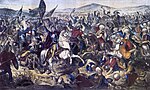
Battle of Kosovo
Battle of Kosovo

The Battle of Kosovo took place on 15 June 1389 between an army led by the Serbian Prince Lazar Hrebeljanović and an invading army of the Ottoman Empire under the command of Sultan Murad I. The battle was fought on the Kosovo field in the territory ruled by Serbian nobleman Vuk Branković, in what is today Kosovo, about 5 kilometers (3.1 mi) northwest of the modern city of Pristina. The army under Prince Lazar consisted mostly of his own troops, a contingent led by Branković, and a contingent sent from Bosnia by King Tvrtko I, commanded by Vlatko Vuković. Additionally, Lazar was also supported by a Christian coalition from various European ethnic groups. Prince Lazar was the ruler of Moravian Serbia and the most powerful among the Serbian regional lords of the time, while Branković ruled the District of Branković and other areas, recognizing Lazar as his overlord. Reliable historical accounts of the battle are scarce. The bulk of both armies were wiped out, and Lazar and Murad were killed. Murad's assassination is attributed to a Serbian knight named Miloš Obilić. The battle marked the only time in history when an Ottoman Sultan was killed in battle. Serbian manpower was depleted and had no capacity to field large armies against future Ottoman campaigns, which relied on new reserve forces from Anatolia. The Serbian principalities that were not already Ottoman vassals, became so in the following years. The mythologization of the battle and writings began shortly after the event, though the legend was not fully formed immediately after the battle but evolved from different originators into various versions. In Serbian folklore, the Kosovo Myth acquired new meanings and importance during the rise of Serbian nationalism in the 19th century as the Serbian state sought to expand, especially towards Kosovo which was still part of the Ottoman Empire. In modern discourse, the battle would come to be seen as integral to Serbian history, tradition and national identity. Vidovdan is celebrated on June 28 and is an important Serbian national and religious holiday as a memorial day for the Battle of Kosovo.